
AeiROBOT demonstrates ALICE at CES 2026 as Jensen Huang cites its robot pairing in NVIDIA keynote
The Hanyang University spin-off showed Alice 4 and Alice M1 working together in a manufacturing and logistics workflow; NVIDIA's CEO cited the demonstration in his CES keynote, and the company is now running industrial trials in shipbuilding and construction in Korea.
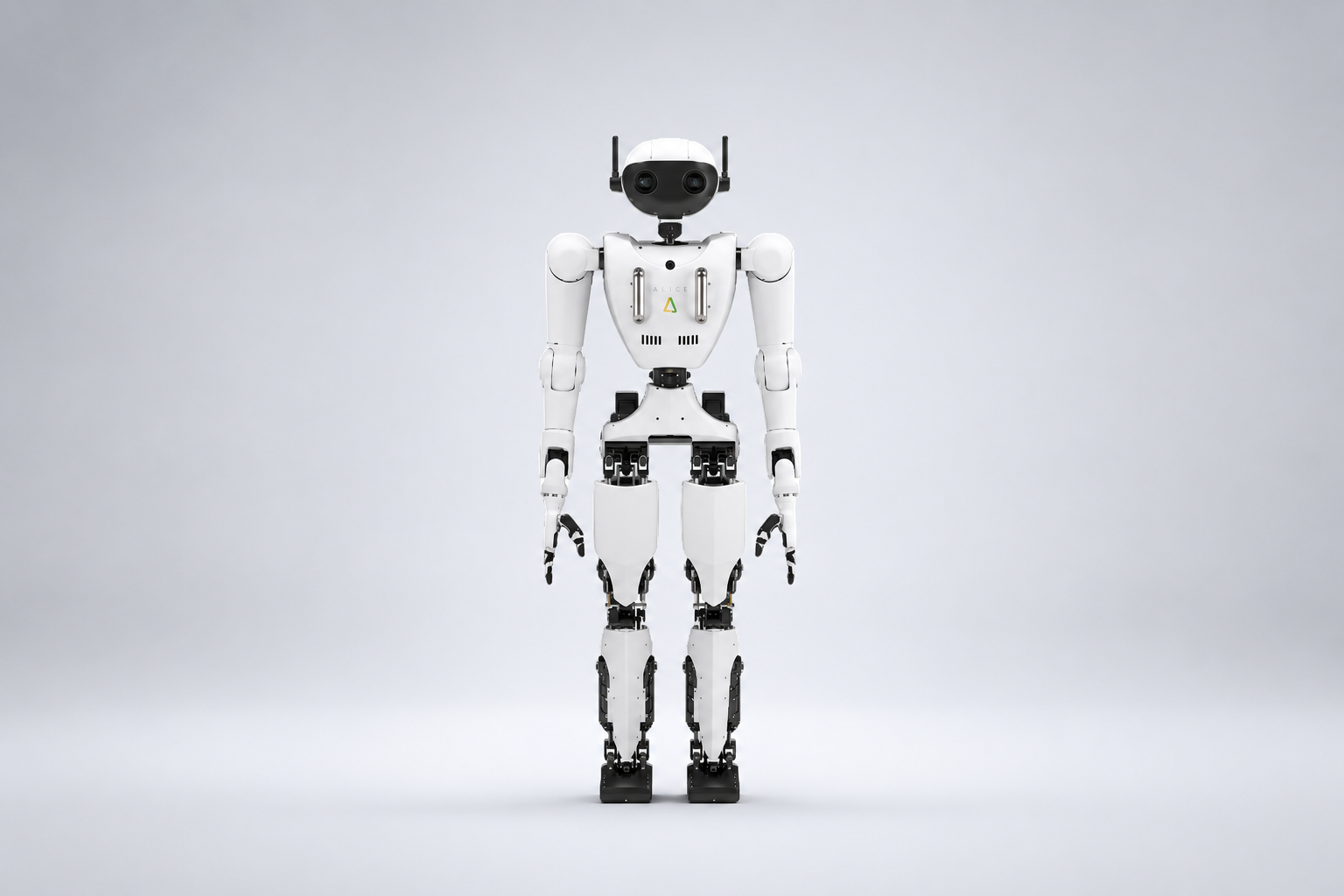
At CES 2026 on January 6, AeiROBOT demonstrated its ALICE humanoid lineup at the Humanoid M.AX Alliance pavilion, showing Alice 4, a bipedal robot, and Alice M1, a wheeled platform, operating together on a manufacturing and logistics workflow. The demonstration was cited by NVIDIA CEO Jensen Huang as a use case in his keynote address.
AeiROBOT was founded in 2018 as a spin-off from the robotics research team of Professor Jaekweon Han at Hanyang University ERICA, through a laboratory focused on humanoid robot systems. CEO Yunseol Um serves on the executive committee of the K-Humanoid Alliance, the South Korean government-backed industry consortium for humanoid robotics development. The company's stated goal is to build humanoid platforms suited for immediate field deployment rather than research demonstration, under the positioning "A Robot for All." ALICE 4 is now being deployed in real industrial environments including shipbuilding and construction, marking the beginning of large-scale field trials in Korea for humanoid robots.
The robots and the strategy
Alice 4 is a 160-centimetre bipedal humanoid weighing 45 kilograms with 41 degrees of freedom, built around proprietary gearless linear actuators without reducers, enabling quiet, energy-efficient operation with precise force control. It runs an NVIDIA Jetson Orin NX processor and supports natural language understanding, multimodal perception, VR-based teleoperation, and imitation learning.
Alice M1 is a wheeled semi-humanoid platform with an adjustable telescoping waist that extends its operating height between 130 and 180 centimetres. The wheeled base provides stable omnidirectional navigation in industrial environments where bipedal walking adds cost and risk without operational benefit.
At CES, Alice 4 recognised a tumbler and transferred it into a box, adjusting grip strength and wrist angle. Alice M1 collected the organised items, placed them on a conveyor belt and returned for subsequent tasks. The pairing divides dexterous manipulation and mobile transport between the bipedal and wheeled platforms.
Technology and validation
AeiROBOT is a member of NVIDIA's Inception Program and has adopted NVIDIA's Isaac GR00T platform for full-body humanoid control, integrating walking control, environmental perception, and autonomous decision-making. At GTC 2025 InnoVEX in Taiwan, AeiROBOT won both the NVIDIA Award and the Okinawa Innovation Award; NVIDIA highlighted the company as an early adopter of Isaac GR00T in its official communications. Alice M1 also runs Advantech's AFE-R360, an industrial computing platform built on the Intel Core Ultra series and designed specifically for real-time sensor fusion and stable motion control in robot deployments.
Funding
AeiROBOT completed a $7.2 million Series A in July 2025, led by BonAngels Venture Partners, Korea Development Bank, NH Venture Investment, and Innopolis Partners, with existing investors Hana Ventures, SGC Partners, and Gauss Capital Management participating. Total funding reached approximately $9.7 million following a $2.5 million seed round the previous year.
AeiROBOT is conducting industrial trials and targets completion of demonstration projects in manufacturing, shipbuilding and construction by 2028, followed by mass production of affordable humanoids.
Have a robotics update Korthos should review? Send news, deployments, product releases, funding rounds, research, or media to [email protected] or reach out on X at @agkorthos.