Google DeepMind demonstrates Gemini 4 Argon on Apptronik Apollo through video-to-simulation robotics pipeline
Google’s video-to-simulation workflow produced an internal Apollo cornhole demonstration, alongside experiments in robot control and training-data generation.
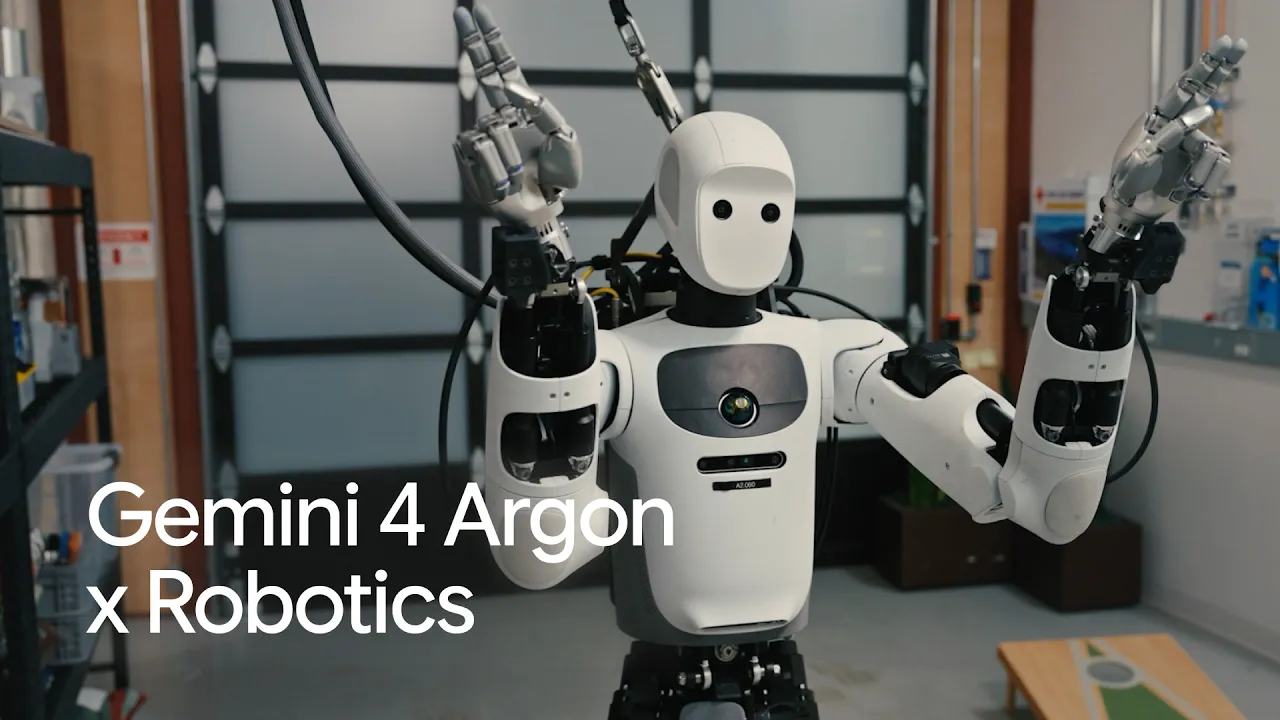
Google DeepMind has demonstrated its Gemini 4 Argon frontier model generating robotic simulation environments and motion trajectories from human video, including a physical trial in which Apptronik's Apollo humanoid successfully completed seven consecutive cornhole throws. The demonstration accompanied Argon's broader release on 13 October, following its initial limited announcement on 30 September. Google reports that the model achieved 87% on the Embodied Reasoning Question Answering (ERQA) benchmark, which evaluates spatial and physical reasoning in three-dimensional environments. The score measures reasoning performance rather than real-world robotic task completion.
In the cornhole experiment, Argon analysed video of a person throwing beanbags, reconstructed the spatial arrangement of the environment and calculated the joint movements required for a humanoid robot to perform the task. It generated simulation code and whole-body motion trajectories before transferring the resulting behaviour to Apptronik's Apollo platform for physical execution. Google describes the process as video-to-simulation-to-real transfer, with the model handling environment reconstruction and code generation rather than serving simply as a low-level motor controller. The company reports that the simulation development process was reduced from weeks of manual work to several hours in its internal demonstration.
Google's accompanying robotics documentation describes additional uses for Argon across robot control, simulation construction, dataset processing and iterative training. One experiment uses camera recordings from a real robot to reconstruct a MuJoCo simulation, matching both visual observations and fingertip contact forces. Another converts egocentric human manipulation footage into a simulated 76-degree-of-freedom bimanual humanoid with 22-degree-of-freedom hands. In a separate tabletop experiment, Argon generated more than 4,500 simulated training episodes from a single workspace photograph, with Google reporting that subsequent real-robot task success improved from 56% to 75% and average completion time fell from 35 to 24 seconds. These results are individual Google-reported experiments rather than general performance guarantees.
The development builds on Google DeepMind's existing robotics programme and its collaboration with Apptronik, first announced alongside Gemini Robotics in March 2025. Its more recent Gemini Robotics 2 models, introduced on 30 July 2026, focus on whole-body robot control and dexterous manipulation across multiple embodiments, including Apollo. Argon adds general-purpose reasoning, simulation engineering, code generation and dataset analysis to that ecosystem. The 13 October release makes Argon available through Google's developer and enterprise platforms as well as supported consumer products, but the Apollo cornhole demonstration remains an internal research result rather than a generally available robot skill or deployment.