
Kinisi builds KR1 around practical warehouse humanoids
The robotics startup is building KR1 as a wheeled humanoid for logistics and manufacturing tasks, with onboard intelligence, hot-swappable batteries and a form factor designed to avoid the cost and instability of legs.
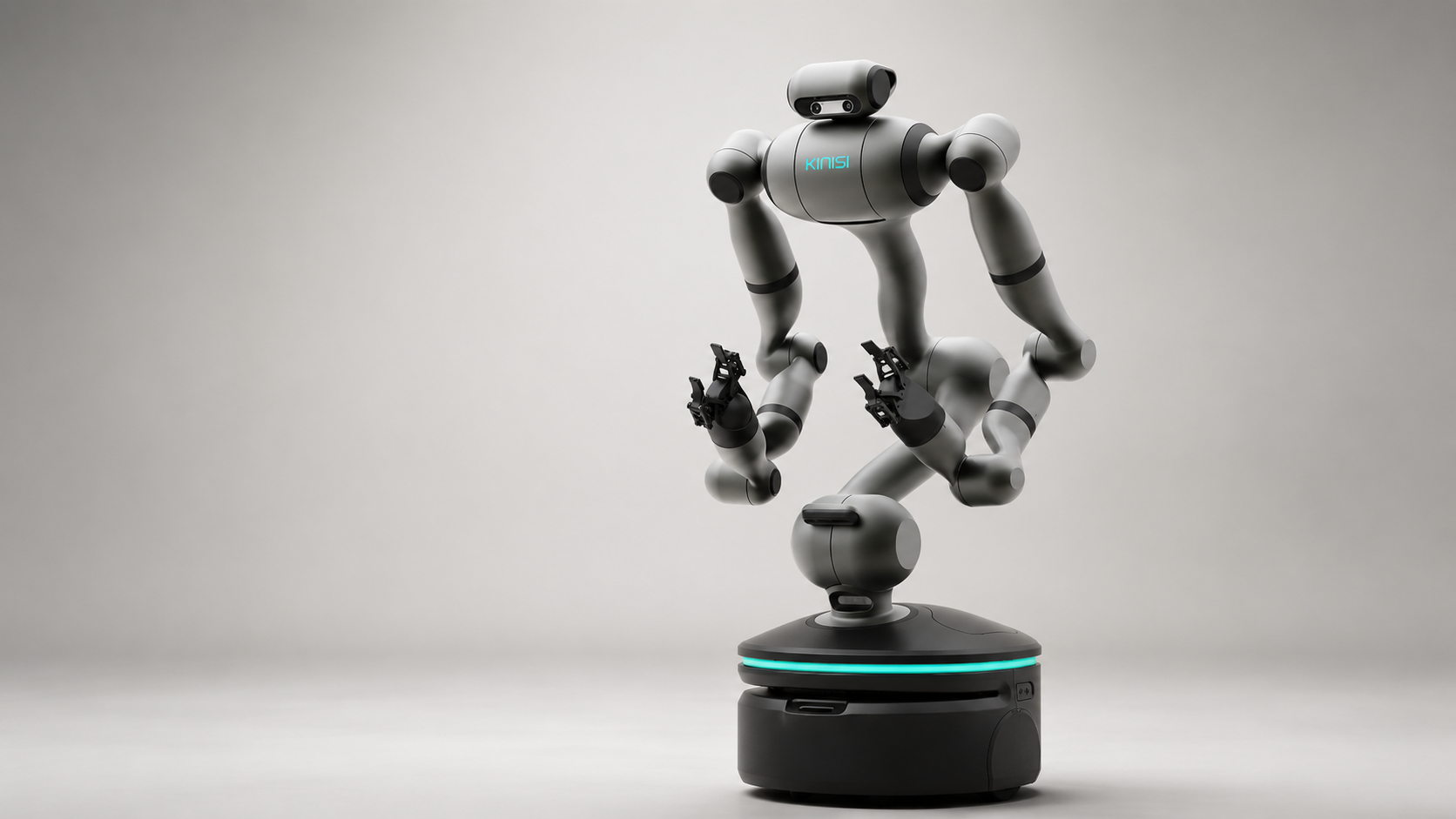
Kinisi has introduced KR1, a wheeled humanoid robot designed for warehouse and manufacturing work where human-like manipulation is useful but bipedal walking adds cost and control complexity.
The company describes KR1 as a robot for picking, loading, transporting, stacking, assembly and maintenance tasks, with onboard intelligence, local processing and a wheeled base for fast movement across structured industrial floors. Kinisi says the robot can be trained through simple demonstrations and deployed with minimal setup, positioning it for task-level automation in logistics and storeroom operations.
Kinisi was founded by Bren Pierce, whose background runs through humanoid robotics research, Robotize and Bear Robotics. Kinisi says Pierce spent a decade in research labs and studied humanoid robotics at the Technical University of Munich, then built and scaled robotics companies that deployed more than 10,000 robots globally and raised more than $180 million from investors including SoftBank.
Pierce’s public argument is that many buyers are fixated on anthropomorphic robots even when specialist or semi-specialist forms can be cheaper and more effective for business-to-business work. In Tech.eu, he framed the near-term opportunity around robots that ship at lower price points and solve real operational problems, especially where automation produces measurable return on investment.
The Robot
KR1 keeps the humanoid upper-body logic while removing legs. The robot uses a wheeled omnidirectional base, two arms and task-focused manipulation hardware for industrial environments. Kinisi’s own product materials list a top speed of 2.4 metres per second, 25 kilogram dynamic payload, 40 kilogram static load, active damping, zero-turn movement, stereo depth cameras, 180 degree LiDAR with SLAM, an NVIDIA Jetson main processor, hot-swappable 48 volt battery packs and six to eight hours of runtime under typical industrial duty cycles.
Kinisi’s site describes the robot as vertically integrated, with motion hardware, perception AI and software tuned in-house, and all core processing handled locally rather than relying on continuous cloud connectivity.
The Deployment Logic
Kinisi says KR1 learns tasks through demonstrations. The company uses live pilots to refine reliability, safety and usability before wider deployment.
Kinisi has released KR1 specifications and says it is preparing for full production.
Have a robotics update Korthos should review? Send news, deployments, product releases, funding rounds, research, or media to [email protected] or reach out on X at @agkorthos.