
NVIDIA expands Isaac robotics stack with Isaac OS, Lab 3.0 and Human 1M
Isaac OS connects robot hardware and AI, while Lab 3.0, Human 1M and SimReady Central expand training and simulation resources.
NVIDIA has expanded its Isaac robotics platform with the Isaac OS runtime, Isaac Lab 3.0, simulation assets and human activity data. Announced at GTC Berlin on 21 October, the release connects data generation, robot learning and deployment through new software and reference workflows.
Isaac OS is an open-source runtime built on NVIDIA Holoscan. It connects AI models, sensors, control software and robot hardware for deterministic real-time execution, providing the runtime layer between trained policies and physical machines.
Isaac Lab 3.0 is generally available as an open-source robot-learning framework. Its multi-backend architecture provides shared asset, scene and sensor interfaces. Researchers can use Isaac Sim for photorealistic scenes or run the Newton physics backend independently, with multi-GPU workflows for training and refining policies. This lets teams select simulation and rendering configurations around the task and available computing resources.
The SimReady Central library supplies more than 2,000 prepared robotics and factory assets. Human 1M combines human activities with synchronised three-view video and 3D hand tracking. Related materials are distributed through Hugging Face, while access to the full Human 1M dataset is available to Cosmos Coalition partners.
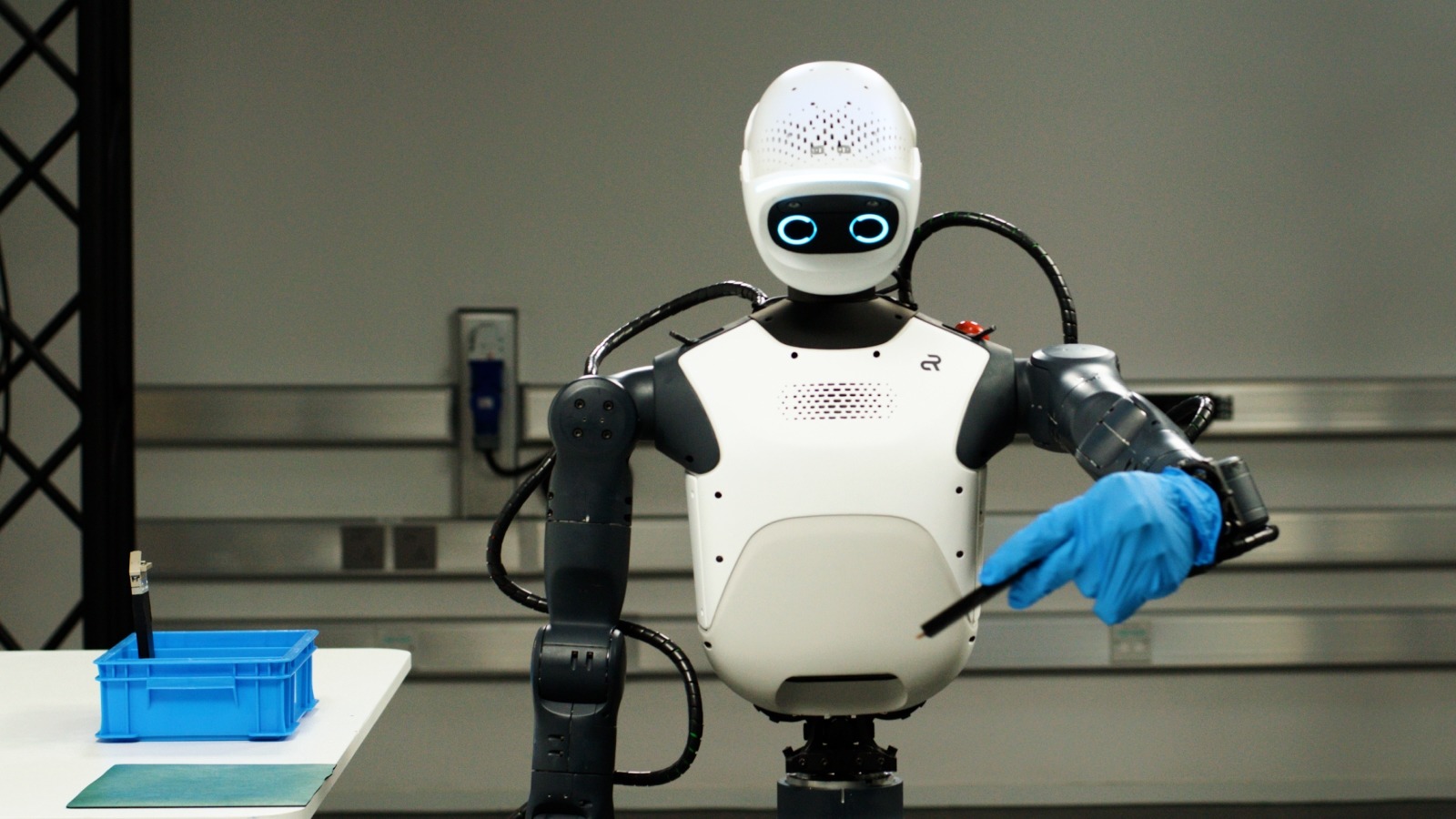
Three reference workflows for DGX Station cover reinforcement-learning refinement of GR00T 1.7 models, dexterous manipulation training in Isaac Lab and post-training Cosmos world models for synthetic data generation using ChatGPT Astra. The release also includes Agile Robots’ Agile ONE SN reference humanoid, which packages GR00T and Jetson Thor with a compact body and tactile hands for research from early 2027.
European partners are applying different parts of the stack to industrial systems. ABB Robotics is integrating Omniverse libraries with RobotStudio HyperReality for virtual commissioning, while Sereact is using GR00T and Cosmos Transfer to train its Cortex goods-handling platform on Universal Robots arms. Hexagon Robotics is using Jetson Thor, Holoscan Sensor Bridge, Halos and Isaac OS for AEON perception capabilities including localisation, mapping and object-pose detection.