
Physical Intelligence opens Pi API beta for robot model training and deployment
The waitlisted beta combines managed model fine-tuning and cloud inference, with early applications ranging from autonomous loaders to dual-arm manufacturing.
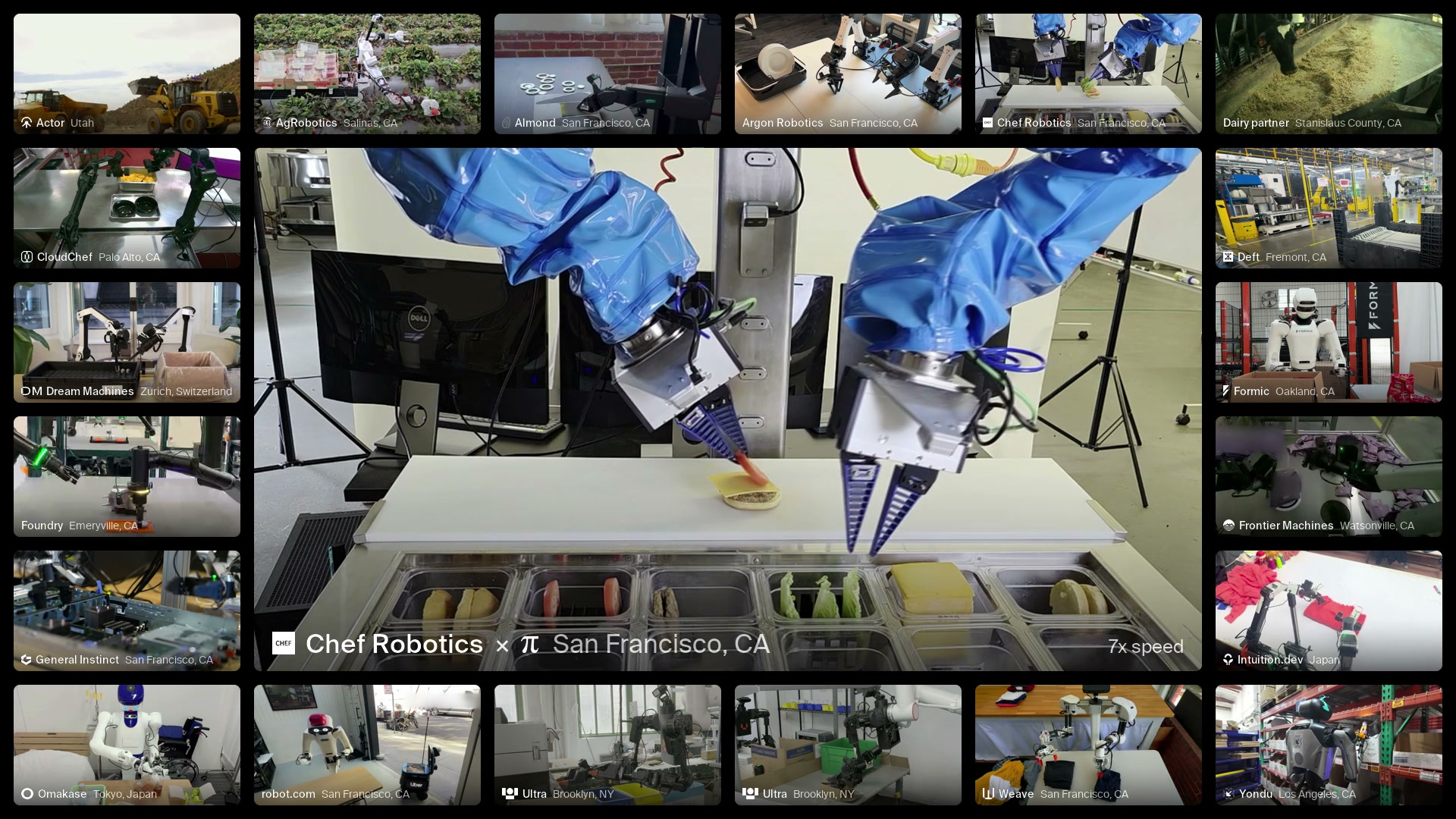
Physical Intelligence has launched the Pi API beta, allowing robotics companies to fine-tune its foundation models on their own task data and run the resulting policies through hosted inference. Announced on 13 October, the service lets developers upload robot demonstrations, train adapted models using Physical Intelligence’s managed computing infrastructure and deploy them on their own hardware. Access is initially limited through a waitlist, with the company planning to introduce newer models as development progresses.
The launch extends Physical Intelligence’s π model family, which includes π0, π0.5, π0.6 and the steerable π0.7 released in April. Adapting the openly available models required developers to manage training infrastructure and data pipelines themselves. The API packages those operations into a service, allowing robotics teams to repeat a cycle of collecting demonstrations, fine-tuning, testing on physical hardware and using failures to guide further training. Physical Intelligence says its latest hosted model improves data efficiency, although it has not specified the exact serving model version or published beta pricing.
Early applications span industrial machinery, manufacturing, agriculture, food preparation and warehouse automation. Actor demonstrated an autonomous wheel loader scooping material into a dump truck during a commercial deployment in Utah without an onboard operator. Almond used the API to develop a policy for its Axol dual-arm robot to deburr spacers used in the robot’s own assembly, reporting a working result after four days of iteration. Most showcased applications operated through cloud-hosted inference across the United States, Japan and Switzerland, with network connectivity identified as a limitation in some deployments.
Physical Intelligence also featured a wider network of robotics collaborators, including Actor, AgRobotics, CloudChef, Weave, Ultra, Almond, Argon Robotics, Chef Robotics, Deft, Dream Machines, Formic Robotics, Foundry, Frontier Machines, General Instinct, Intuition.dev, Omakase, robot.com and Yondu. These represent different stages of model collaboration and early API experimentation rather than a disclosed list of paying customers.
The API follows Physical Intelligence’s February disclosure of live applications with Weave and Ultra. Weave reported fewer failed grasps and human interventions during robotic laundry folding, while Ultra demonstrated autonomous order packaging in customer warehouses. The new service makes the model adaptation and deployment infrastructure available to additional robotics developers without requiring each company to reproduce Physical Intelligence’s training stack.