
Rhoda adds tactile sensing to DVA model for vision-free robot manipulation
Rhoda's tactile-enabled Direct Video-Action model retrieves textured objects with cameras covered, extending its video-predictive control approach.
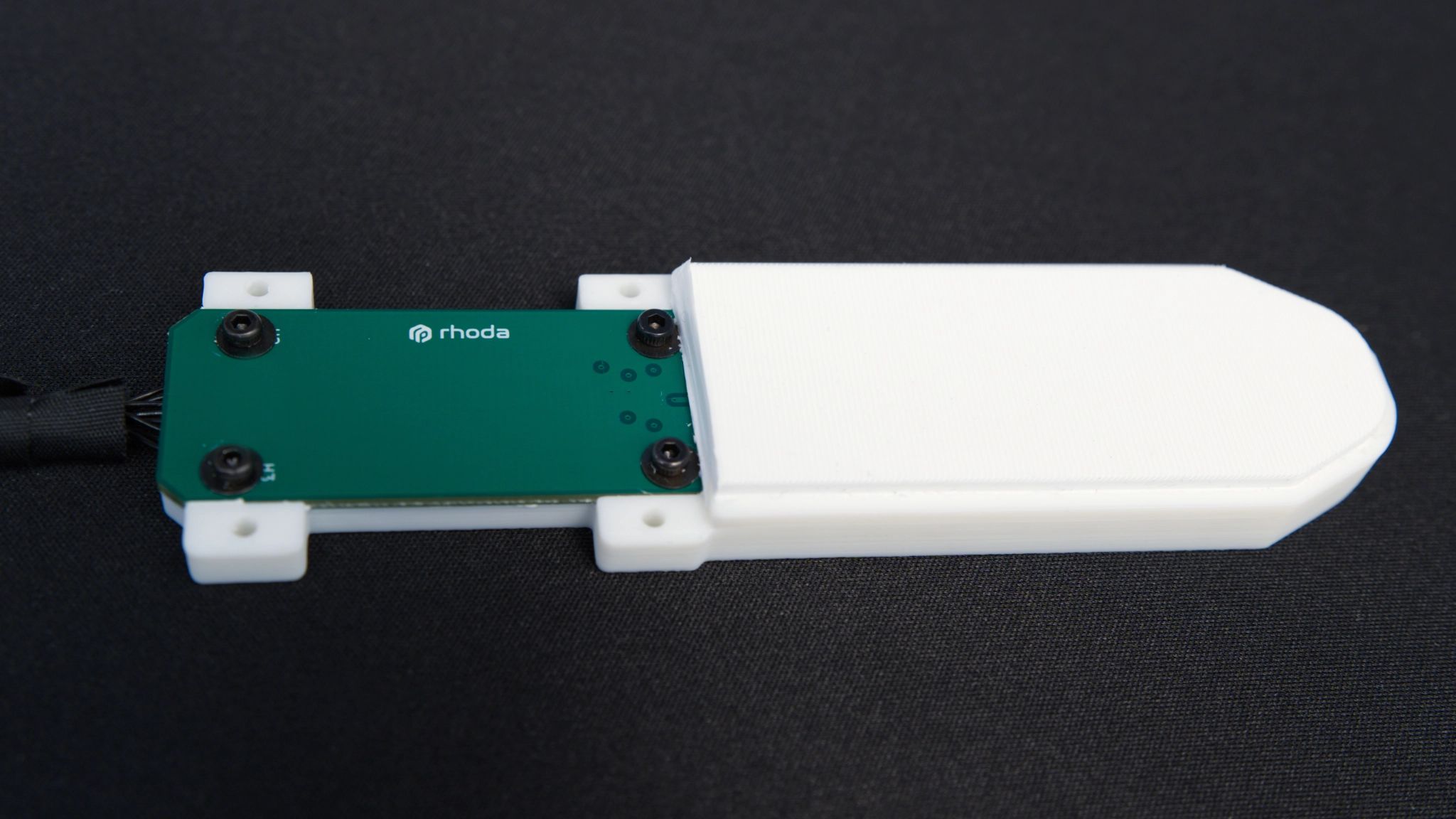
Rhoda AI has developed a compact tactile sensor and extended its Direct Video-Action (DVA) model to use touch feedback, demonstrating a robot searching for and retrieving textured objects with both its head and wrist cameras blocked. In research published on 13 October, the robot distinguished a textured ball from a smooth one by contact, then used the same trained model to identify textured targets among seven balls, including two it had not seen during training that differed in size, firmness and surface texture. Rhoda published extended autonomous demonstrations but did not disclose trial counts or a quantified success rate for the blindfolded task.
The gripper-mounted sensor measures normal and shear contact forces from a few millinewtons to more than 40 N, with tactile signals sampled at approximately 500 Hz to detect rapid vibrations and surface differences. It also records spatial temperature changes, and Rhoda integrated the hardware into a handheld Universal Manipulation Interface to collect contact-force data during human demonstrations. The tactile-enabled DVA model predicts future sensor readings alongside video observations, with a separate inverse-dynamics model translating those predictions into robot movements. During the blindfolded test, tactile readings provide the feedback needed to search, identify objects and adjust grasps without camera input.
Rhoda emerged from stealth in March with a $450 million Series A at a $1.7 billion valuation, introducing FutureVision and its video-predictive approach to industrial robot control. In September research, the company tested how internet-video pre-training affects real-robot performance on an industrial bearing-unpacking task, including more than 200 hours of evaluation. The new work adds physical contact information to that model architecture and to its demonstration-data collection pipeline. The tactile results cover controlled object-selection experiments; broader industrial performance has yet to be established.