
RoboParty unveils RP1 open-source humanoid ahead of Q4 production program
RP1 combines Romomo actuators and PartyOS control, with an October open-source roadmap and a Q4 production program planned.
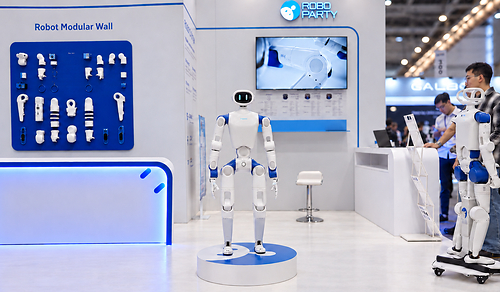
Shanghai-based RoboParty has unveiled RP1, also called ROBOTO 01, a bipedal humanoid designed as an open development platform for embodied AI research, model training and robotics development. The robot made its public debut at IROS 2026 in Pittsburgh on September 28, extending the company’s earlier ROBOTO ORIGIN project into a higher-performance platform combining its own actuators, motion-control stack and developer software.
RP1 uses RoboParty’s in-house Romomo actuator modules and delivers peak joint torque of up to 160 N·m. At IROS, visitors were invited to push and kick the robot; RoboParty says RP1 demonstrated posture adjustment, disturbance recovery and fall recovery. Its motion stack uses PartyOS together with UFO, an unsupervised reinforcement-learning framework for acquiring low-level humanoid motor skills, including transitions and recovery behaviours.
The open-source element extends beyond the robot’s mechanical design, although the complete RP1 stack has not yet been released. RoboParty plans to progressively publish motion-control systems, simulation environments, SDKs, training tools and its PartyOS development foundation. A detailed RP1 open-source roadmap is due in October, followed by broader hardware and software releases and a mass-production program later in Q4 2026.
RP1 follows ROBOTO ORIGIN, RoboParty’s first fully open-source bipedal platform, released in January. The company reports more than 2,500 GitHub stars for that project and a developer community exceeding 5,000 members. It has since expanded its stack with Romomo actuator modules and the RP Hand for dexterous manipulation. RP1 brings those hardware and software efforts into a single humanoid development platform.
Founded in 2025, RoboParty disclosed nearly RMB500 million across Angel++ and Pre-A rounds in July. Shunwei Capital, Matrix Partners China, Xiaomi’s strategic investment arm and SenseTime-backed Guoxiang participated in the Angel++ financing, while CATL was the sole investor in the Pre-A round. The company said the funding would support hardware production ramp-up alongside PartyOS and its humanoid foundation-model work.