
The drone stack is being rebuilt around the layers beneath the aircraft
New investment targets drone flight control, positioning, communications and domestic component production.

The drone stack is being rebuilt from lower down
HYFIX raised $15 million in April to build a U.S.-made autonomy chip for drones and robots. The company says its system-on-chip combines flight control, high-precision positioning, secure communications, and onboard compute in a single package, supports ROS 2, ArduPilot, and PX4, and is designed for GPS-degraded or spoofed environments. The product is aimed at a part of the autonomy stack that is still often assembled from separate flight controllers, GNSS modules, radios, and compute units, with the integration overhead, weight, power draw, and failure points that follow from that architecture.

Grand View Research estimates the commercial drone market at $30.02 billion in 2024, $33.04 billion in 2025, and $54.64 billion by 2030, implying a 10.6 percent compound annual growth rate from 2025 through 2030. Asia Pacific accounted for 30.8 percent of the market in 2024. Beyond visual line of sight operations are expected to be the fastest-growing operating-range segment, with growth above 11.2 percent over the forecast period.
Currently the market is still shaped heavily by DJI. SCSP estimates that DJI holds more than 90 percent of the global consumer drone market, nearly 70 percent of the overall drone sector, and close to 80 percent of the U.S. commercial segment. The same report says DJI products account for 70 to 90 percent of drones used across U.S. commercial, government, and consumer applications. DJI’s position was built through integrated manufacturing, supplier access, and system control across the stack rather than through the aircraft alone.
RUSI argues that attempts to build sovereign drone capacity continue to run into Chinese strength across the component and materials base, including semiconductors, permanent magnets, sensors, and other critical inputs.
Recent U.S. policy has increased pressure on future supply without resetting the installed base. The FCC added certain foreign-produced uncrewed aircraft systems and critical components to the Covered List on December 22, 2025, then updated the rules on January 7, 2026 to exempt limited categories including systems on the Blue UAS Cleared List and some domestic end products. The immediate effect is to tighten the path for new market entry and future procurement. It does not remove the fleets, dependencies, and installed workflows already in the field.
Standard GPS is sufficient for coarse navigation, but inspection, mapping, surveying, autonomous landing, and coordinated robotic operations require tighter repeatability. RTK uses correction data from ground reference stations to reduce meter-level drift to centimeter-level positioning.
HYFIX and GEODNET are linked through Mike Horton and address complementary parts of drone positioning and control. HYFIX is building device-side silicon that integrates control, compute, communications, and positioning functions more tightly at the hardware level. GEODNET is building the RTK network layer that supports precision positioning outside the device. Based on the current figures pulled from GEODNET sources, the network stands at 21,288 stations across 159 countries, 297,600.055 GB of RTK usage, and $9.24 million in annual recurring revenue.
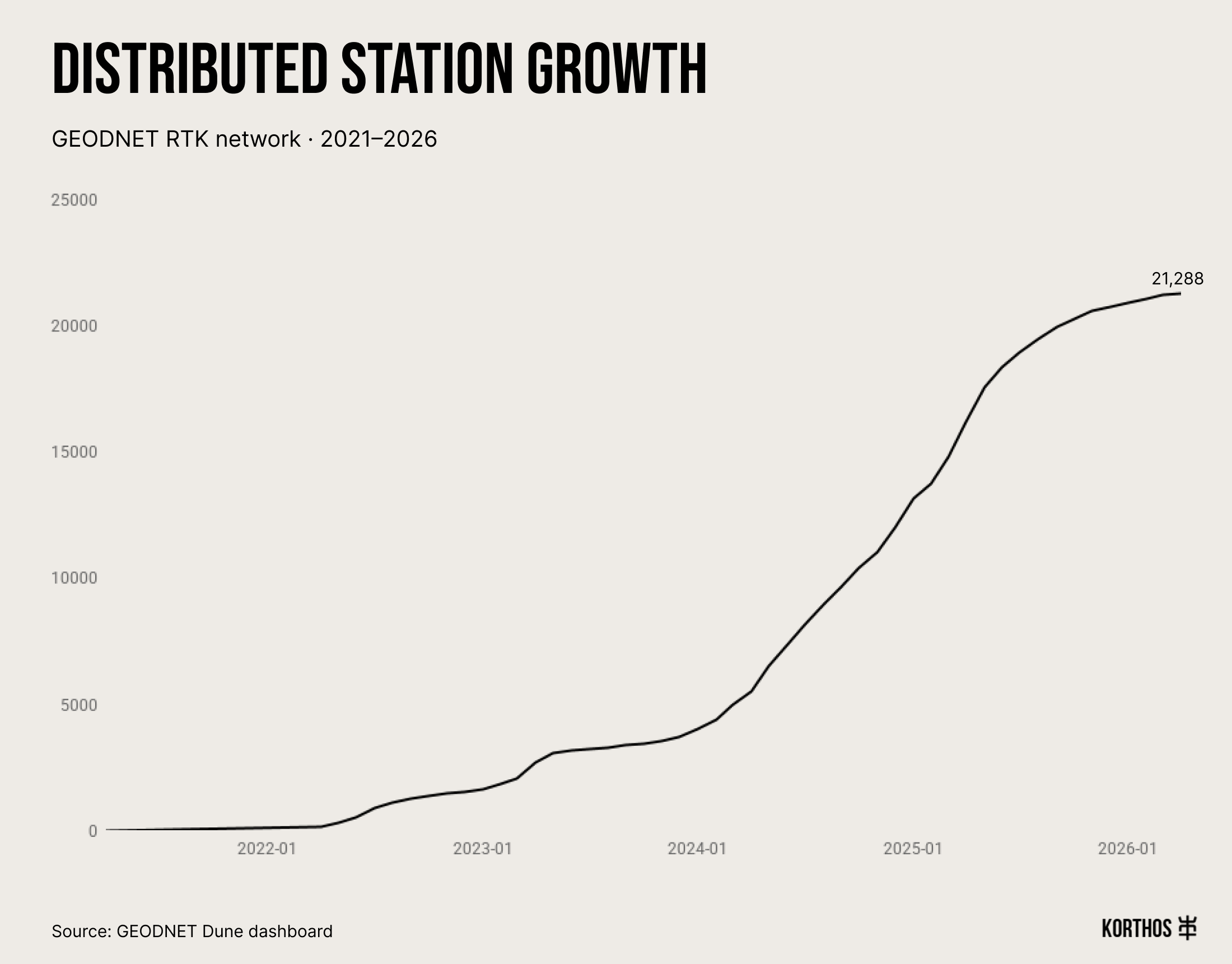
HYFIX integrates drone-control components into a chip, while GEODNET supplies an external positioning network.
Have a robotics update Korthos should review? Send news, deployments, product releases, funding rounds, research, or media to [email protected] or reach out on X at @agkorthos.