
ZINOVA launches Tool Intelligence stack for robot tool use
The San Jose company is building a cross-robot layer for grasping, sensing and operating existing tools, starting with construction.
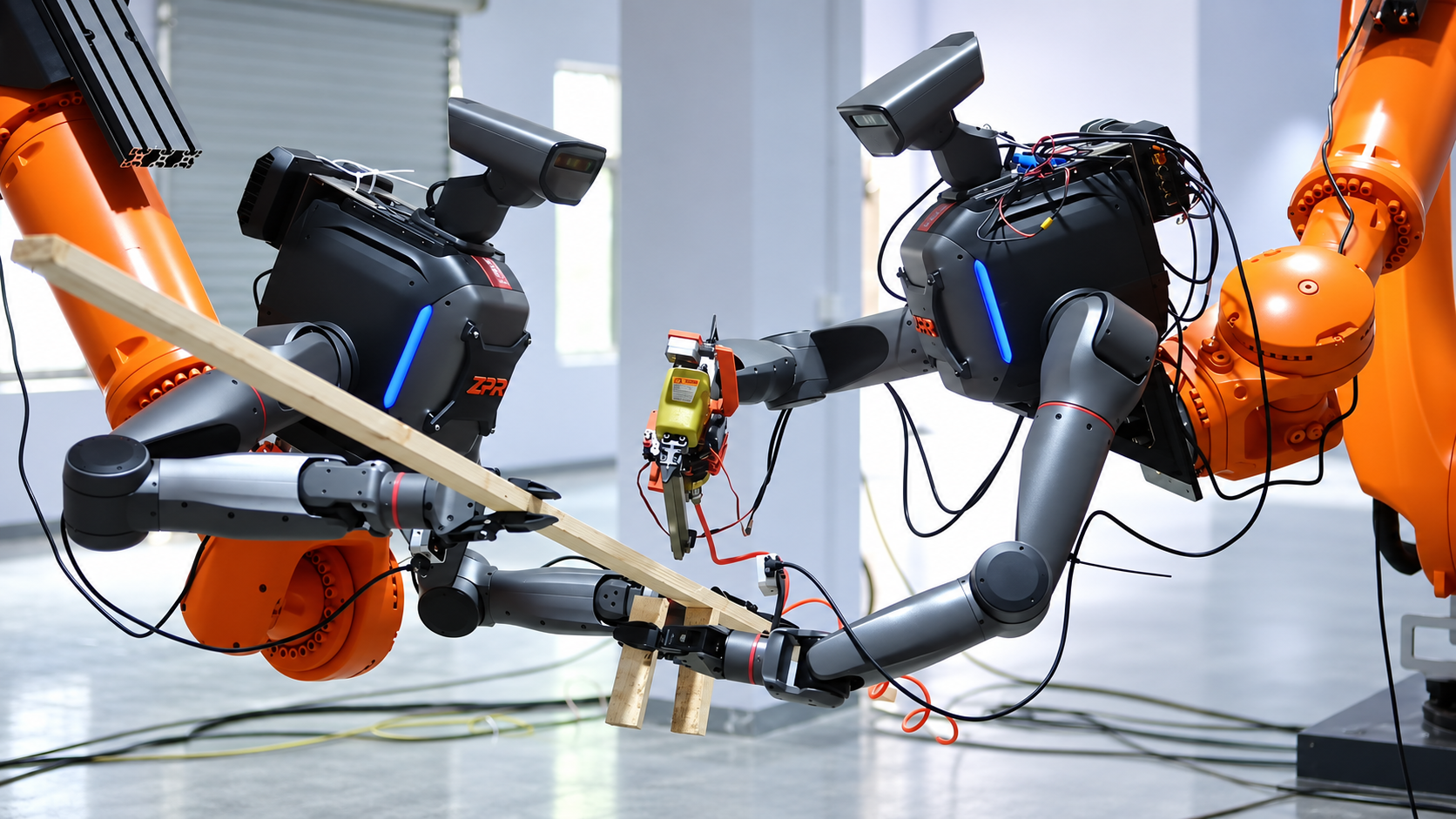
ZINOVA has launched as a new Physical AI research company focused on enabling robots to use existing human tools across different tasks and robot forms.
The San Jose launch is led by CEO Ryan Cox and founder Ziyou Xu, both of whom have worked on construction robotics through RIC Robotics. ZINOVA is operating separately from RIC, with the latter providing construction expertise and a potential route into jobsite testing and commercialization.
ZINOVA calls its approach Tool Intelligence, a hardware and software layer for recognising, grasping, sensing and operating tools without designing a new robot or custom end effector for every task.
The research is split across three areas. General Tool Grasp covers picking up and manipulating tools designed for human hands. TEISI, or Tool–Embodiment Interaction Sensing Interface, measures force, torque, vibration, resistance and contact between the robot, tool and material. The Third Form covers robot configurations designed around the work itself rather than human anatomy, including systems with greater reach or payload.
Its first public system combines LimX Dynamics’ TRON 2 dual-arm upper body with KUKA industrial arms. The setup has been demonstrated assembling formwork, placing and tying rebar and working on a scaled steel-reinforced concrete tilt-up panel. The industrial arm extends the working envelope while the TRON 2 upper body provides dual-arm manipulation and tool handling.
That configuration was first shown publicly earlier this month. The Sept. 14 announcement formally introduces ZINOVA and the Tool Intelligence architecture behind the demo rather than representing a new demonstration itself. The initial demonstration is a scaled validation environment, not a jobsite deployment.
ZINOVA plans to use construction as its first validation environment. The company says deployments can initially operate with human supervision through Robotics-as-a-Service, with people handling edge cases while completed work generates tool-interaction data for training and evaluation. Its launch materials describe a loop in which real deployments produce both revenue and new operational data.
Construction is the initial market, with manufacturing, energy, maintenance, infrastructure and aerospace also identified as potential applications for the same tool-use layer.
Have a robotics update Korthos should review? Send news, deployments, product releases, funding rounds, research, or media to [email protected] or reach out on X at @agkorthos.