
Digit’s Legs Make More Sense Once You Trace the Lineage
Digit’s leg design follows locomotion research on ATRIAS and Cassie at Oregon State University.
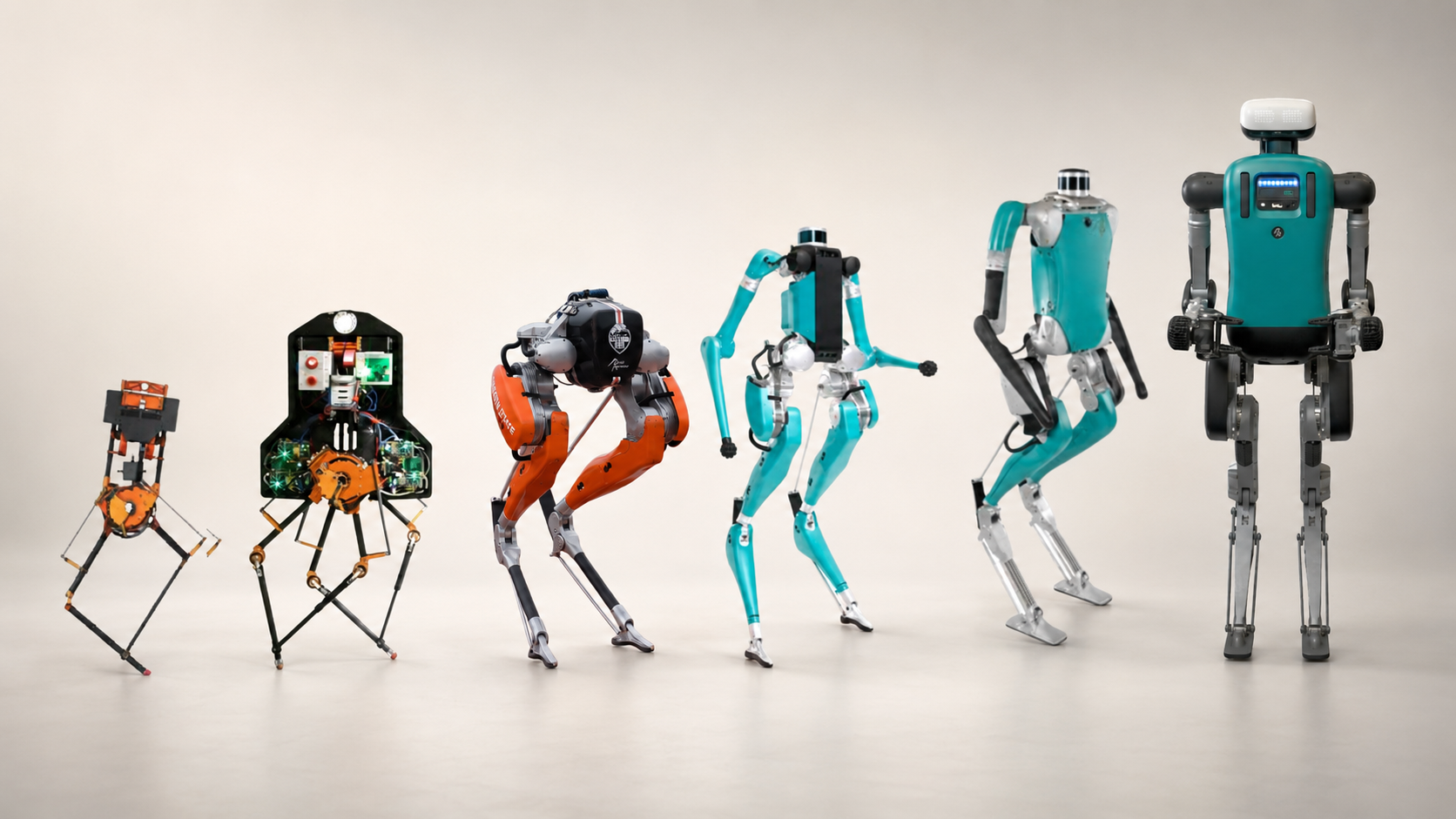
One of the most interesting aspects of robotics is watching a sped up evolutionary process; new life forms with new limits emerging at an unnatural rate.
Of all humanoid-adjacent robotics, one of the more interesting design stories is Agility Robotics and Digit. A clear differentiator is the leg geometry. Instead of optimizing for a more human-like silhouette, the team ended up with a backward-bending, bird-like configuration that looks unusual at first but makes more sense once you trace where it came from. The configuration lets the leg store and release energy more efficiently during each step, reducing the power needed to maintain gait.
That story goes back to Oregon State University and ATRIAS, a research biped developed to reproduce key human walking gait dynamics. From there came Cassie, which took the locomotion work further into a more practical legged platform before Digit ever existed as a commercial robot. OSU explicitly describes the sequence as ATRIAS, then Cassie, then Digit.
OSU said Cassie’s leg configuration emerged from research into legged locomotion mechanics and from solving inefficiencies in earlier designs. The result looked like an ostrich or other ground-running bird, but the goal was efficient, robust movement through stairs, curbs, and uneven ground.
In 2021, it completed an untethered 5K on Oregon State’s campus on a single battery charge. In 2022, it set the Guinness World Record for the fastest 100 meters by a bipedal robot, running the distance in 24.73 seconds from a standing start and returning to a standing position without falling.
Digit is deployed in Amazon and GXO warehouses, moving totes through facilities designed for human workers.
Have a robotics update Korthos should review? Send news, deployments, product releases, funding rounds, research, or media to [email protected] or reach out on X at @agkorthos.