
Medra launches AI Experimentalist for autonomous lab planning and execution
The DARPA-backed project connects scientific reasoning with robotic wet-lab execution, following the April opening of Medra’s 38,000 sq ft ML001 facility.
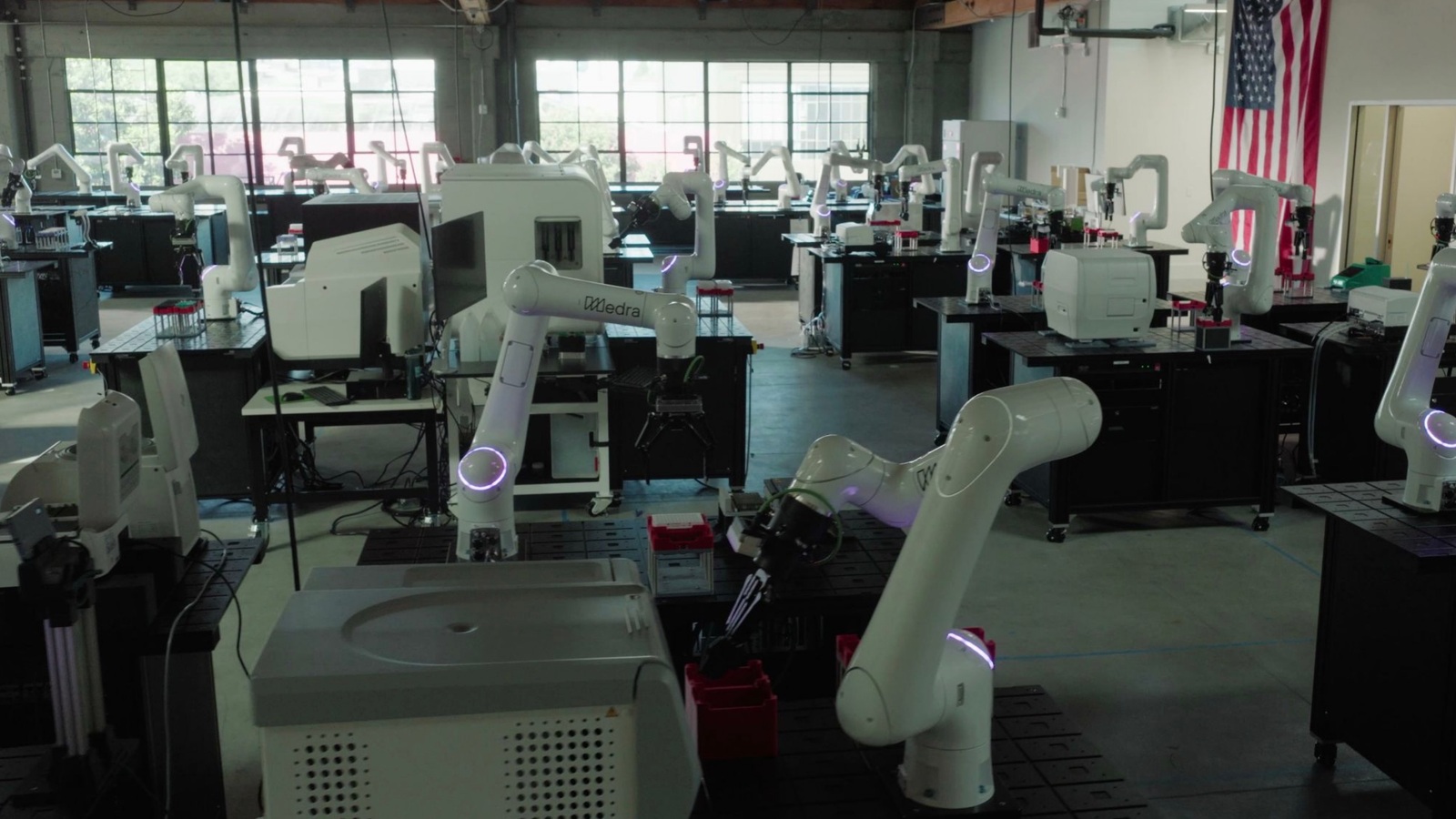
Medra launched its AI Experimentalist on 24 June 2026, adding scientific planning and reasoning to the robotic execution layer of its Physical AI Scientist platform. The company also disclosed a DARPA-funded project to translate natural-language research objectives and human-written protocols into executable experiments. Selected closed-beta projects are running across academia, biopharma and government at Medra Lab 001, its San Francisco autonomous laboratory.
The system covers literature review, experiment design, wet-lab coordination, results analysis and protocol refinement. A model-agnostic agent framework combines frontier models with specialised scientific agents and prediction tools, while the Physical AI Lab carries out the experiments. Scientists retain control of research objectives, with successive runs using measured results to revise the next experimental plan. Customers can access the platform through on-site installations or remotely through ML001.
Medra introduced ML001 in April as a 38,000 sq ft facility with hundreds of robots, bringing hypothesis generation, physical execution and analysis into one site. Its vision-language lab-action model operates existing laboratory instruments and monitors bench activity for errors. The company identified Genentech among its partners and described applications in antibody discovery, protein engineering, gene editing, genomics and cell biology. ML001 also supplies experimental data for biological-model developers and serves as a reference installation for pharmaceutical companies considering their own automated facilities.
The laboratory expansion followed Medra’s US$52 million Series A in December 2025, led by Human Capital with existing investors Lux Capital, Neo and NFDG and new participants including Catalio Capital Management, Menlo Ventures and 776. That announcement identified Genentech, Cultivarium and Addition Therapeutics as partners and allocated funding to team growth, partnerships and the planned 2026 autonomous lab.