
Nature Will introduces 50B-parameter Natura-1 model for dexterous robotic manipulation
Natura-1 combines human-video pretraining with dexterous-hand control, evaluated on ROKAE AR5 robots equipped with WUJI hands.
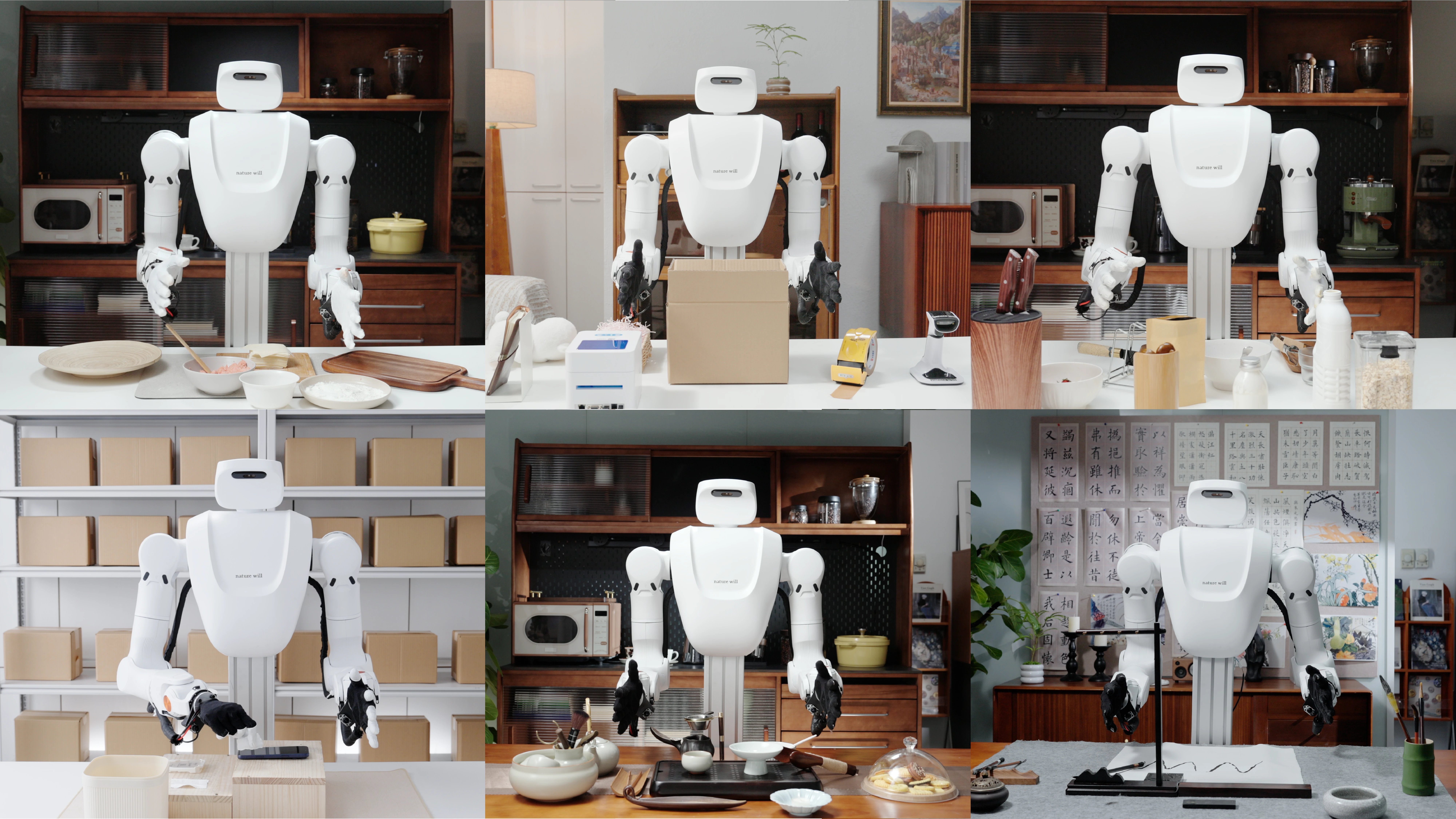
San Francisco-based physical AI company Nature Will has introduced Natura-1, a 50-billion-parameter mixture-of-experts foundation model pretrained on more than one million hours of egocentric human data to control dexterous robotic hands. The model combines language, vision, world modelling and action generation within a single architecture, operating 20-degree-of-freedom robotic hands through a 100-millisecond observation-to-action loop. Founded by CEO Ning Ding, Nature Will is developing the data infrastructure, training systems and robotic control technology needed to transfer manipulation capabilities from human experience to physical machines.
Natura-1's training pipeline extracts three-dimensional hand poses from human video and organises activities into language-conditioned action trajectories, spanning complete tasks, intermediate stages and individual movements. The company reports a curated dataset of one million hours and a distributed training infrastructure processing hundreds of thousands of hours of footage each week, with training running across hundreds of GPUs. Following pretraining, Nature Will uses a smaller dataset of physical robot demonstrations to adapt the model to robotic manipulation. Its inference system overlaps observations, computation and action transmission to maintain the 100-millisecond control cycle.
Physical evaluations use ROKAE AR5 dual-arm robots equipped with WUJI dexterous hands, combining commercially developed robot hardware with Nature Will's manipulation model. On the company's own benchmark covering 12 dexterity dimensions, Natura-1 scored 53.4 in its Base configuration and 59.1 with agentic assistance. Nature Will also evaluated Physical Intelligence's π0.5 and a frontier multimodal coding-based policy, neither of which achieved a scored result on its dexterous-hand platform within the stated evaluation conditions. Separate gripper-based comparisons produced scores of 13.5 and 16.7, although the different end effectors and control approaches mean those results are not directly equivalent.
The company demonstrated instruction-following tasks involving unfamiliar objects, multi-object constraints and coordinated manipulation, including loading a tray, wiping a surface, preparing ingredients and transferring objects between hands. Six additional long-horizon demonstrations, ranging from packaging a shipping box to applying a phone screen protector, used further task-specific tuning on top of the foundation model. Nature Will also reported instances of improvised manipulation, including using a rod to retrieve objects beyond the robot's reach and changing grasping strategy when conventional approaches were impractical. The demonstrations and benchmark results are company-reported, with no independent validation established in the release.