
Nucleus shows 101-minute uncut factory run
Nucleus’ full recording shows a wheeled dual-arm robot handling parts-store logistics, with corrections left visible.
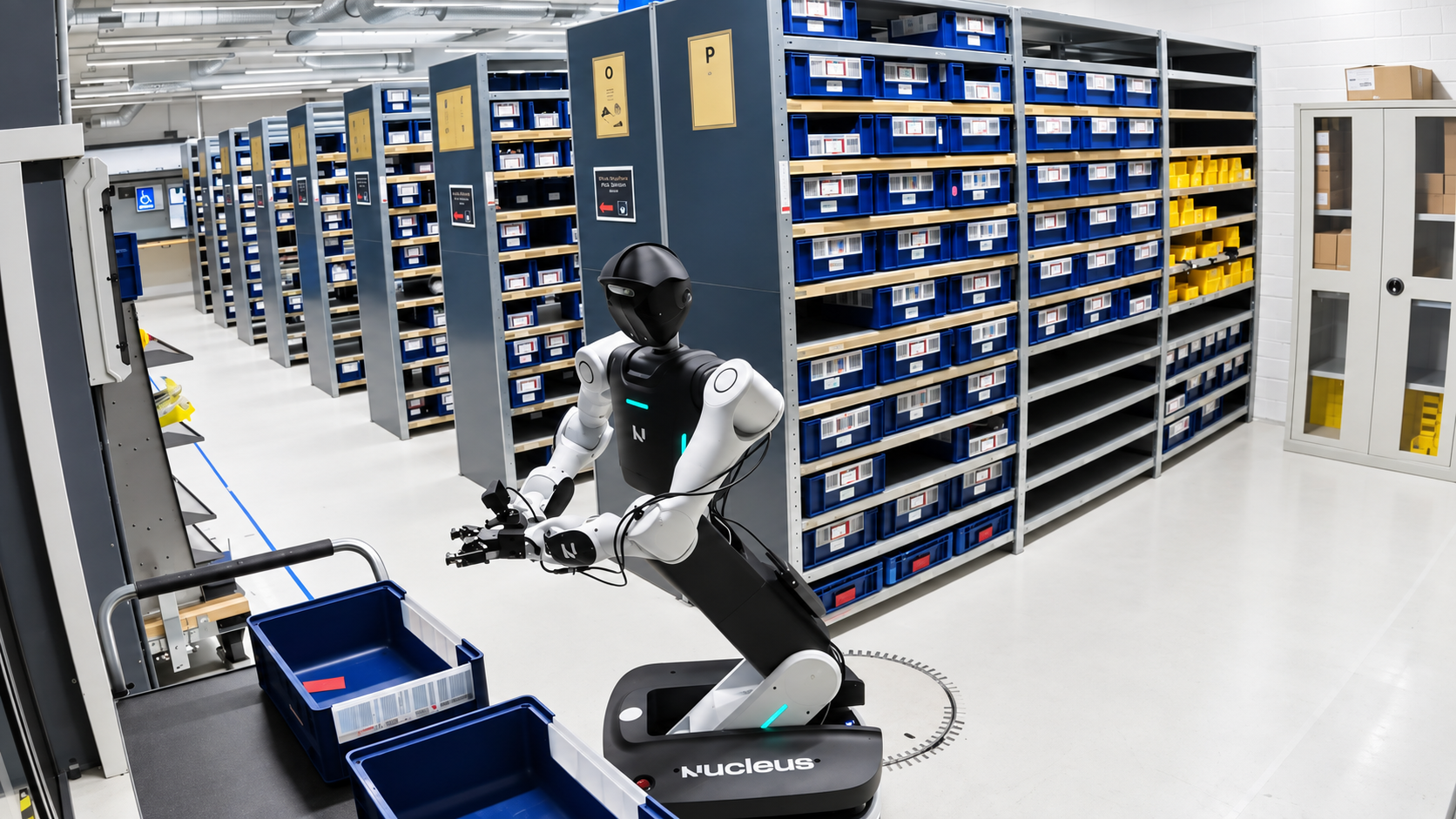
Nucleus has published an uncut factory recording showing its wheeled dual-arm robot completing an intralogistics workflow, with hesitations and corrections left visible. The 67-minute, 14-second video is shown at 1.5× speed, representing approximately 101 minutes of underlying operation, with multiple camera views and no scenes removed.
The demonstration connects three stages inside an industrial parts store: loading containers onto a cart, transferring them from the cart to shelving, and retrieving containers to stage the next operation.
Founder and CEO Melvin Schwarz says Nucleus is now regularly running four-to-six-hour shifts, with robots carrying complete jobs from start to finish. His announcement does not describe those shifts as fully autonomous. Nucleus uses human intervention and teleoperation corrections as part of its deployment and training approach.
The recording follows Nucleus’ September move to Nucleus II, a wheeled mobile manipulator chosen after factory customers prioritised payload, uptime and safety. Schwarz disclosed up to 10 kg payload per arm and six times the battery capacity of Nucleus I. He described five-to-nine-hour uptime as a customer requirement, rather than a measured endurance result.
Nucleus develops the hardware with a partner and carries its software stack across robot generations. In the earlier deployment demonstration, Schwarz explained that operators intervene through teleoperation when the robot encounters a problem, using those cases to guide further improvements. The operator interface provides vibration-based contact feedback, control over applied force and visual force feedback.
Nucleus emerged from stealth in August and currently markets robotic labour to factories at €25–€45 per hour. Its training pipeline combines visual and depth observations, motion and contact signals, human corrections and task outcomes for evaluation and policy post-training.