
Q1 Results Show Robotics Lidar Is Becoming Measurable
Q1 2026 results from RoboSense and Hesai show robotics becoming a measurable lidar category, with the first volume curve concentrated in China.
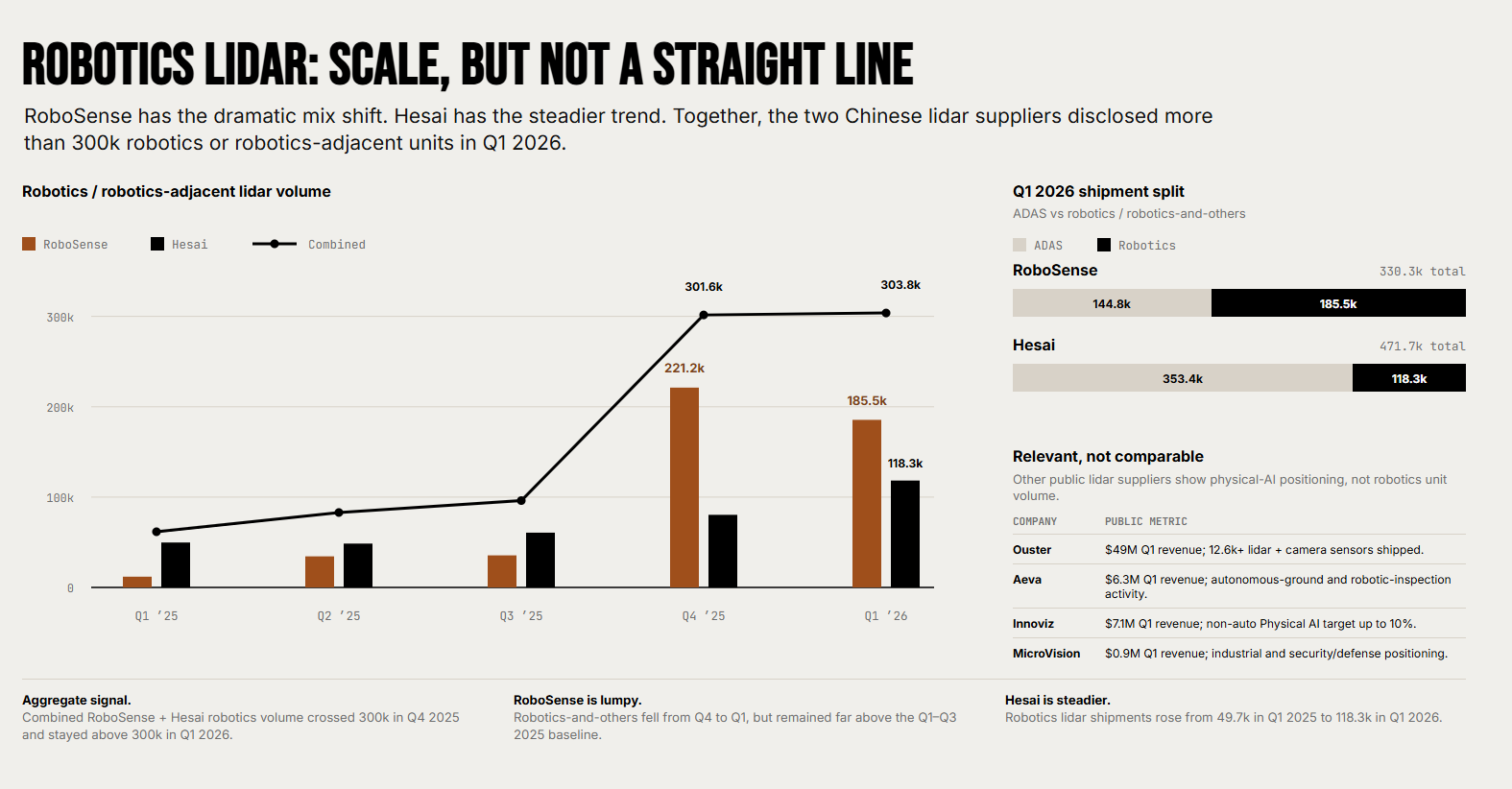
RoboSense and Hesai disclosed more than 300,000 robotics or robotics-adjacent lidar shipments in Q1 2026. RoboSense’s “robotics and others” volume exceeded its ADAS volume for the first time, partly because ADAS shipments fell sharply from Q4. Hesai reported 118,282 robotics lidar shipments in the quarter.
Robots have used lidar for decades, especially 2D safety scanners and guidance sensors in industrial automation. Public supplier disclosures now also show 3D perception lidar showing up at scale in public supplier disclosures.
The RoboSense headline and the caveat that comes with it
RoboSense's Q1 numbers: 185,500 units into "robotics and others," against 144,800 ADAS units, out of 330,300 total shipments. Robotics-and-others was up 1,458.8% year on year. RoboSense discloses the segment as "robotics and others" rather than pure robotics, so the figure includes adjacent categories beyond strict robot platforms. The segment accounted for 56% of total shipments.
RoboSense’s ADAS shipments fell from approximately 238,400 units in Q4 2025 to 144,800 in Q1 2026, while robotics-and-others fell from approximately 221,200 to 185,500. Robotics gained share of total shipments because ADAS declined faster, despite both segments shipping fewer units than in Q4. Source
Hesai: the cleaner trend
Hesai, the larger of the two Chinese lidar suppliers by total volume, reported Q1 2026 robotics lidar shipments of 118,282 units, up 137.8% year on year from 49,731 units in Q1 2025. Unlike RoboSense, Hesai remained ADAS-led, 353,441 ADAS units against 118,282 robotics units out of 471,723 total, but the robotics category has been climbing steadily for five quarters rather than spiking in one. Hesai's Q1 revenue reached RMB680.6 million (approximately $98.7 million), up 29.6% year on year, partially offset by falling average selling prices.
RoboSense's robotics-and-others volume was roughly 11,900 in Q1 2025, then 34,400 in Q2 and 35,500 in Q3, before spiking to 221,200 in Q4 and easing to 185,500 in Q1 2026. Hesai's robotics shipments moved more gradually: 49,731 in Q1 2025, 48,531 in Q2, 60,639 in Q3, 80,372 in Q4, and 118,282 in Q1 2026. That is a steady climb across five quarters.
The aggregate view
Combined RoboSense and Hesai robotics or robotics-adjacent volume crossed 300,000 units in Q4 2025 and stayed above 300,000 in Q1 2026, even as RoboSense declined sequentially, because Hesai continued rising.
The quarterly combined totals: roughly 61,600 in Q1 2025, 82,900 in Q2, 96,100 in Q3, 301,600 in Q4, and 303,800 in Q1 2026. A year ago the combined figure was roughly 60,000. In Q1 2026 it was five times that.
The enabling condition
For robotics, lidar got cheap enough, small enough, and manufacturable enough to fit into AMRs, delivery robots, cleaning robots, robotic lawn mowers, inspection systems, and embodied AI platforms at volumes that matter commercially.
Hesai said higher shipments increased Q1 revenue, partially offset by lower average selling prices. RoboSense’s full-year 2025 robotics revenue rose 257.7% while unit shipments rose 1,141.8%. Unit growth therefore outpaced revenue growth at both suppliers.
The cost curve ran first through automotive ADAS programs, which created the manufacturing infrastructure and chip architecture, RoboSense's proprietary SPAD-SoC and VCSEL chipsets, produced at automotive-grade AEC-Q certification, that then made robotics-grade sensors viable at lower price points. ADAS scale built the supply chain that robotics is now accessing.
Where the volume is coming from
RoboSense breaks out its application segments: robotic lawn mowers, autonomous delivery, humanoid robots, embodied AI, and commercial cleaning robots. The company holds the top shipment position across all five categories according to GGII's Q1 2026 global 3D lidar ranking. Its named partners include Unitree, AgiBot, Galbot, EngineAI, and DOBOT, and the company says in its Q1 press release that it has partnered with nearly 50 humanoid and quadruped robot companies in total, the majority of which it has not publicly identified. In May, RoboSense received a large-scale order from a leading European humanoid robotics company for its new Active Camera sensor, an expansion beyond lidar into active vision.
Hesai's named robotics customers at CES 2026 included MOVA (robotic lawn mowers), Roboterra (humanoid robots), Vbot (commercial cleaning robots), and Realsee (3D spatial digitalization). Since then, the company has announced an exclusive design win with Zelos, powering Honor's humanoid robot Lightning with its JT128 lidar, the robot that broke the human world record at the first humanoid half marathon and Unitree, which selected the JT128 for all its humanoid robots featured at the 2026 Spring Festival Gala. Hesai also unveiled Kosmo, a handheld spatial intelligence device targeting physical AI applications including humanoid robot training and simulation.
One detail worth flagging: Unitree appears in the named customer lists of both companies, suggesting either a non-exclusive supply relationship or a transition between suppliers. Neither has clarified the arrangement publicly.
Both companies are Chinese, and their robotics customers are overwhelmingly part of China's domestic manufacturing ecosystem.
Two categories of evidence
RoboSense and Hesai are the only companies reporting hard six-figure quarterly robotics or robotics-adjacent unit disclosures. Everything else belongs to a different category of evidence.
Other public lidar suppliers are increasingly using the same physical-AI language, but their public disclosures still look like product positioning, pilot deployments, mixed sensor shipments, or revenue guidance.
Ouster, now positioning as a sensing and perception platform for Physical AI, reported $48.6 million in Q1 2026 revenue, up 49% year on year, its 13th consecutive quarter of product revenue growth. It shipped more than 12,600 lidar and camera sensors, with lidar around 65% of the total, driven primarily by smart infrastructure and industrial customers. In February 2026, Ouster acquired Stereolabs, adding AI vision and depth perception to its portfolio. In May it launched Rev8, a next-generation digital lidar family with native color sensing and roughly double the range and resolution of prior generations, targeting functional safety certification for advanced robotics and AI perception. The company does not provide a robotics-only shipment breakout.
Aeva reported $6.3 million in Q1 2026 revenue, up from $3.4 million a year earlier. Its robotics-relevant activity included Forterra's expanded use of Aeva 4D lidar in an autonomous ground vehicle and Nikon's launch of the APDIS MV5X laser radar system for automated robotic inspection in aerospace, automotive, and energy facilities. Innoviz reported $7.1 million in Q1 revenue and signed a letter of intent with LOXO for Level 4 autonomous delivery integration, noting that non-automotive Physical AI lidar could account for up to 10% of its FY2026 revenue target.
What the revenue numbers do and don't show
Hesai's Q1 filing shows that higher ADAS and robotics deliveries were partially offset by falling average selling prices, which means a robotics unit surge does not necessarily produce a proportional revenue surge.
RoboSense reported a 39.7% robotics gross margin in 2025, compared with 19.1% for ADAS. Its robotics unit sales and average selling prices need to be read separately when assessing the business’s growth.
What to watch
The suppliers’ disclosures leave several limits on comparison:
RoboSense’s robotics shipments fell sequentially from Q4 2025 to Q1 2026, while Hesai’s robotics shipments increased for a fifth consecutive quarter. Neither trend establishes how much inventory customers were holding.
Segment revenue: Neither company reports robotics-specific revenue alongside the Q1 unit figures.
Other robotics unit disclosure: Ouster, Aeva, Innoviz, and MicroVision are all repositioning around physical AI, but none has disclosed robotics-specific shipment volumes at a scale comparable to RoboSense or Hesai.
Customer concentration: Six-figure quarterly volumes spread across lawn mowers, cleaning robots, delivery robots, AMRs, and humanoid platforms carry different risk profiles than the same volume concentrated in two or three large programs. Neither company has disclosed customer concentration data for robotics.
Gross margin: RoboSense reported a 39.7% robotics gross margin. Future margin disclosures would show whether pricing pressure is offsetting shipment growth.
Have a robotics update Korthos should review? Send news, deployments, product releases, funding rounds, research, or media to [email protected] or reach out on X at @agkorthos.