
China’s Dexterous-Hand Suppliers Are Becoming Unicorns
Xynova’s second major financing in seven weeks adds to a surge of capital, production capacity and standalone suppliers around one of the humanoid’s most difficult components.
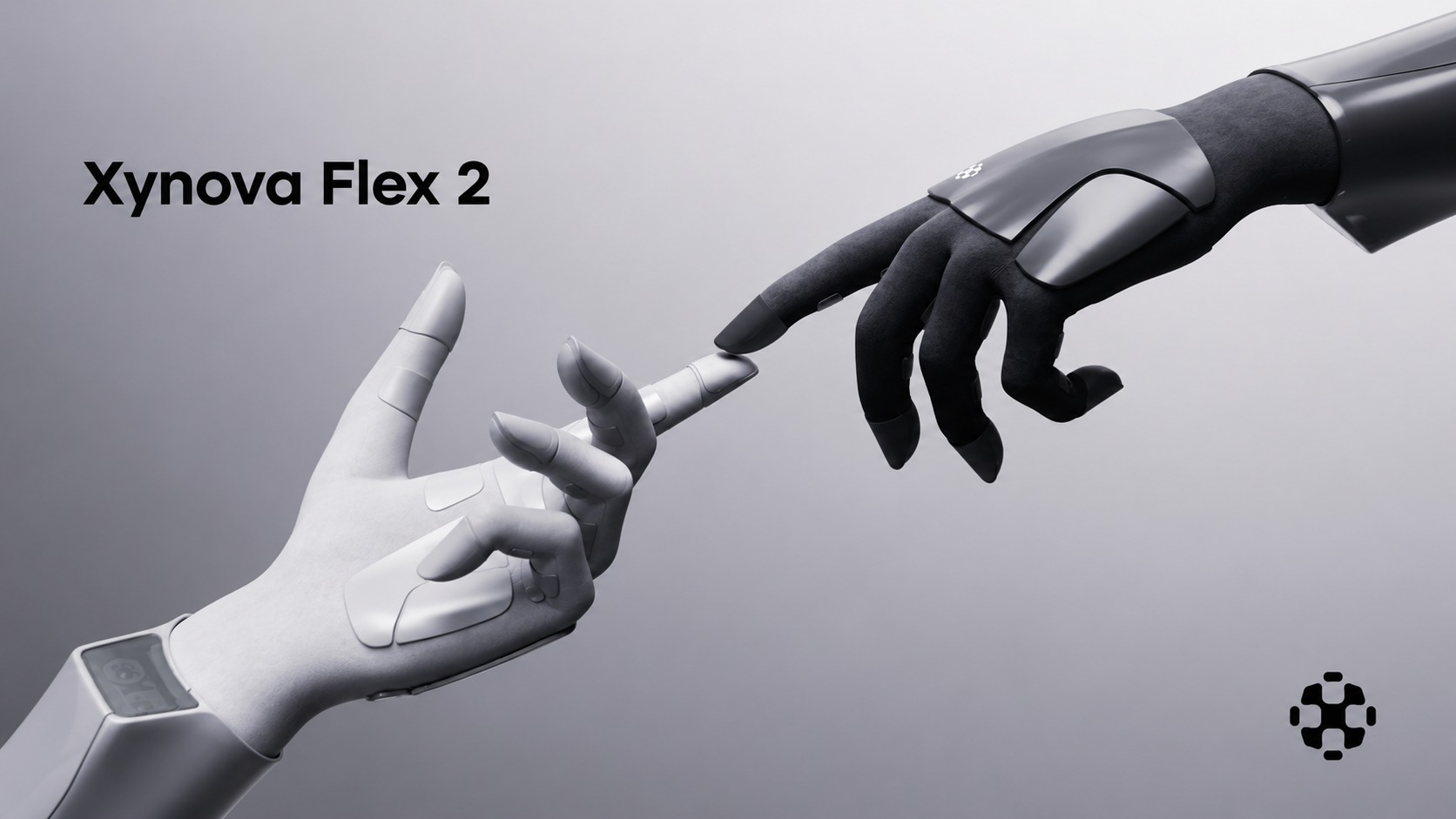
Hangzhou-based Xynova has reportedly completed a RMB 500 million Series A+, roughly $70 million, marking its third financing in four months and arriving only seven weeks after its previous round.
The latest round was led by Meituan, with participation from NIO Capital, China Merchants Capital, an undisclosed major internet company and existing investor Xiaomi. Chinese reporting describes the transaction as taking Xynova into unicorn territory.
Xynova was founded in late 2024.
Xynova has built across several of the most important components inside a humanoid arm, including dexterous hands, integrated joints and miniature linear actuators. Its recently introduced Flex 2 combines tendon transmission with direct motor drive in a 400-gram hand with 23 degrees of freedom.
The company has previously said it plans to establish annual production capacity for 10,000 dexterous hands by the end of 2026.
Suppliers are becoming unicorns
AGILINK announced a financing of nearly RMB 1 billion in June, taking its post-money valuation above $1 billion.
The company was formed from the dexterous-hand operation associated with AgiBot and reached unicorn status after four rounds within roughly five months. It reported more than 8,000 dexterous-hand shipments and over 10,000 additional orders at the time of the financing.
The Beijing-based company raised nearly RMB 1.5 billion in a Series B in February before completing a Series B+ at a reported $3 billion valuation in April. It subsequently told Reuters it was targeting a $6 billion valuation in its next financing.
LinkerBot said it shipped 10,000 hands during 2025. Its standalone products allow the company to sell across multiple robot platforms rather than depend on one manufacturer’s deployment schedule.
LinkerBot has also continued expanding its manufacturing base. Recent Chinese reporting says it now operates four self-built factories and is targeting monthly production above 10,000 hands during 2026, with annual deliveries of 50,000 to 100,000 units. Those remain forward targets, but they show the company building capacity alongside its rapid financing and valuation growth.
Chinese hand suppliers
They are raising for production lines, lowering prices and building capacity ahead of large-scale deployment. Xynova’s planned 10,000-hand capacity, AGILINK’s early shipment volume and LinkerBot’s four self-built factories and expansion targets all point to suppliers preparing for a market larger than current humanoid deliveries.
Dexterous hands can be integrated into industrial arms, mobile manipulators, service robots, teleoperation systems and research platforms.
This creates a different industrial structure from one in which every robotics company develops its own proprietary hand.
Independent suppliers can spread engineering costs across customers, shorten development cycles and allow robot manufacturers to select different hands for research, industrial, domestic or specialised applications.
LinkerBot is developing LinkerSkillNet, a library that it says contains more than 500 standardised hand capabilities. Other companies are combining hardware with teleoperation systems, tactile data and manipulation models.
The product increasingly combines the hand mechanism with data and control software for use across robots and tasks.
Elsewhere in dexterity
Recent Western hand announcements include:
On 9 July, 1X introduced a new 25-degree-of-freedom tendon-driven hand for NEO. The design places the motors in the forearm and uses tendons to transmit force into a compact, human-scale hand. 1X demonstrated fast finger motion, impact resistance and manipulation ranging from tool use to handling delicate objects. The hand remains part of 1X’s vertically integrated humanoid buildout. The company has said it is building production capacity for 10,000 NEO robots this year.
Proception began shipping ProHand 1.0 in late June after raising an $11 million seed round led by First Round Capital, with Y Combinator and BoxGroup participating. The 22-degree-of-freedom, tendon-driven hand uses skin-like contact sensors and was designed with input from hand surgeons. Its paired ProGlove turns the same sensor skin into a wearable system that captures human manipulation directly, without requiring a robot in the loop.
Mimic Robotics unveiled the M1 hand and U1 wearable on July 16 as one integrated dexterity platform. M1 has 15 active degrees of freedom across 21 joints, highly backdrivable tendon actuation and force sensing through both motor current and fingertip tactile sensors. The U1 is a passive exoskeleton that reproduces the hand’s kinematics, contact geometry, sensor placement and wrist-camera viewpoint, creating a direct one-to-one path from human demonstrations into the robot.
Have a robotics update Korthos should review? Send news, deployments, product releases, funding rounds, research, or media to [email protected] or reach out on X at @agkorthos.