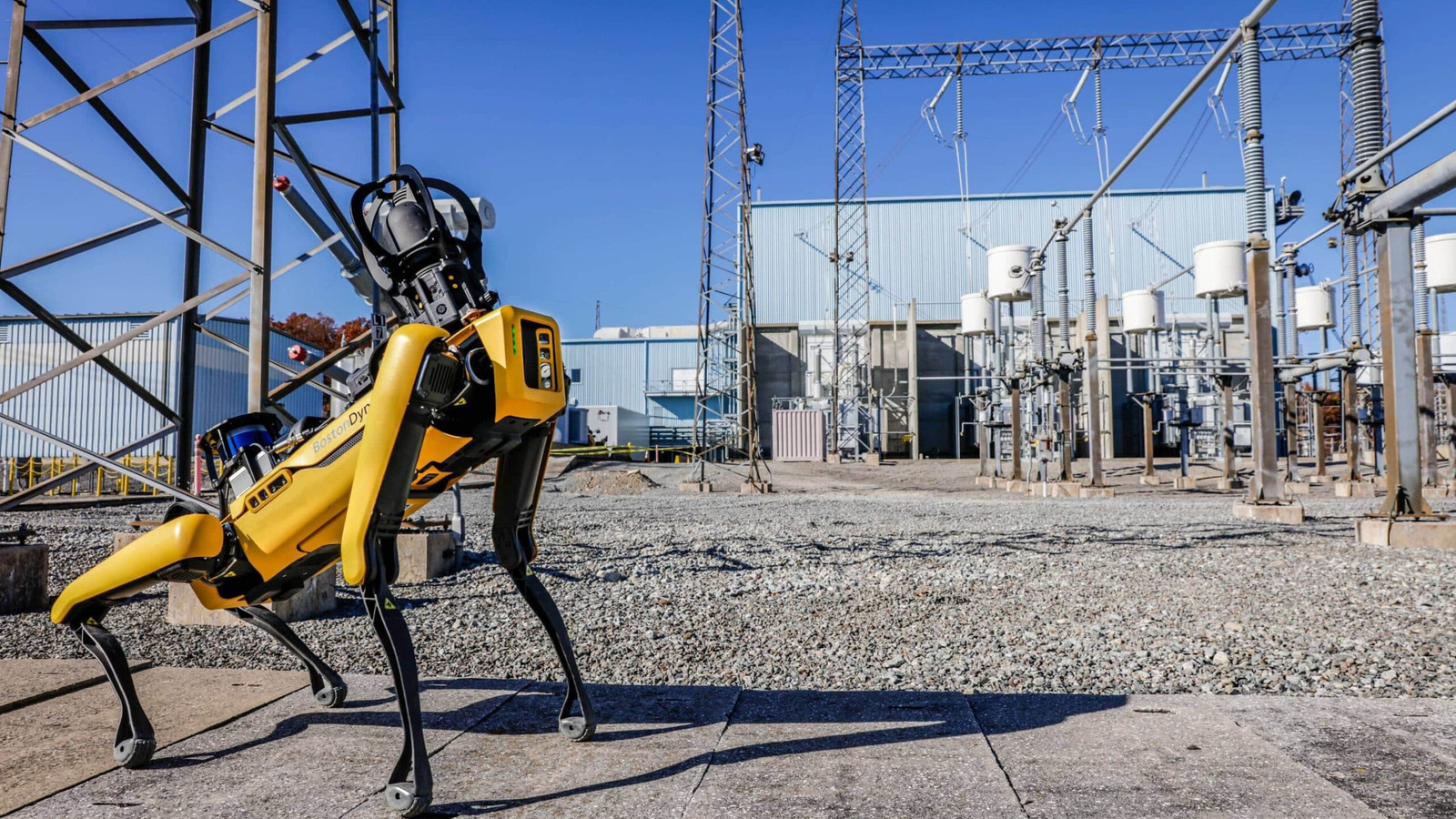
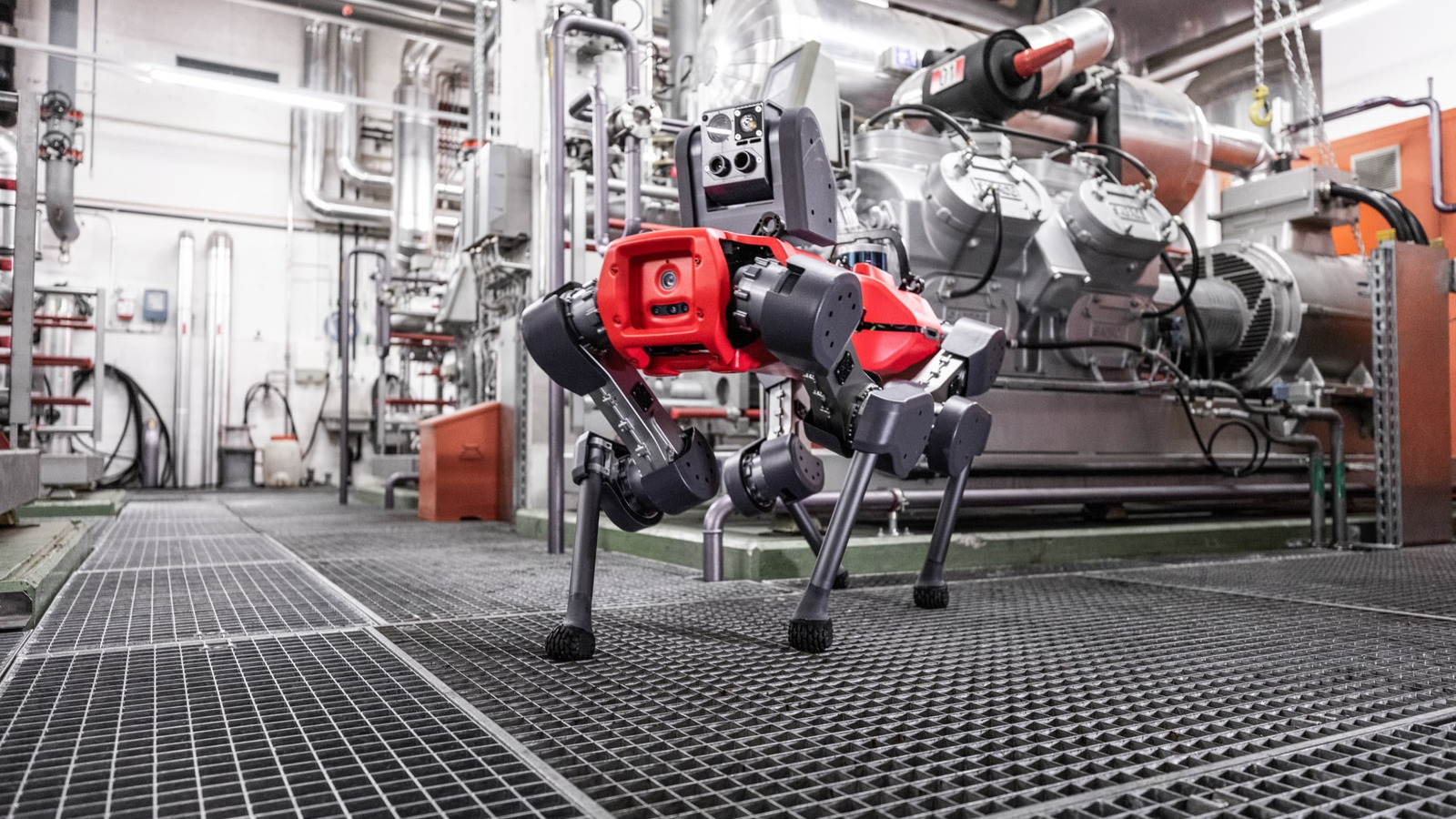
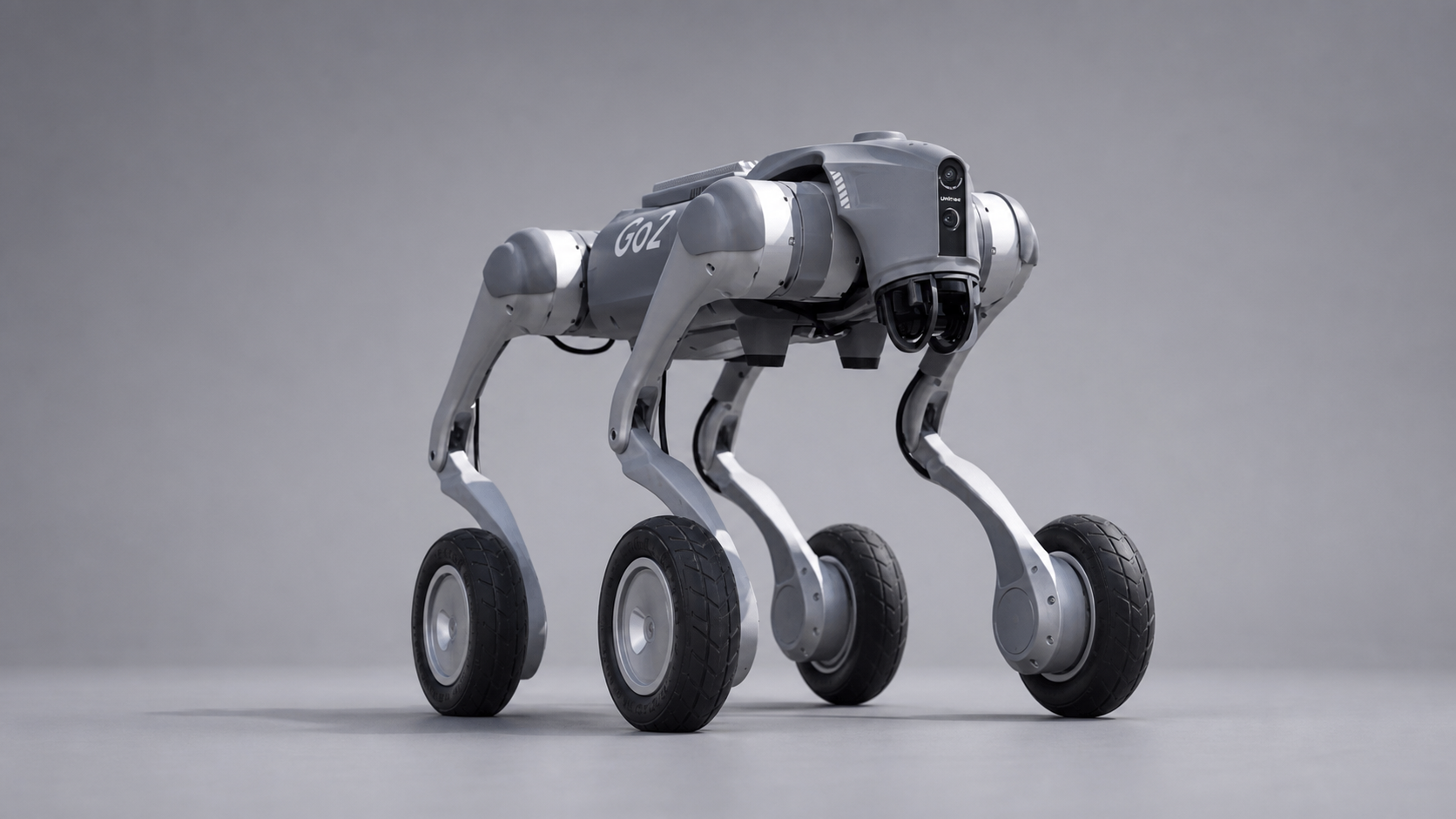
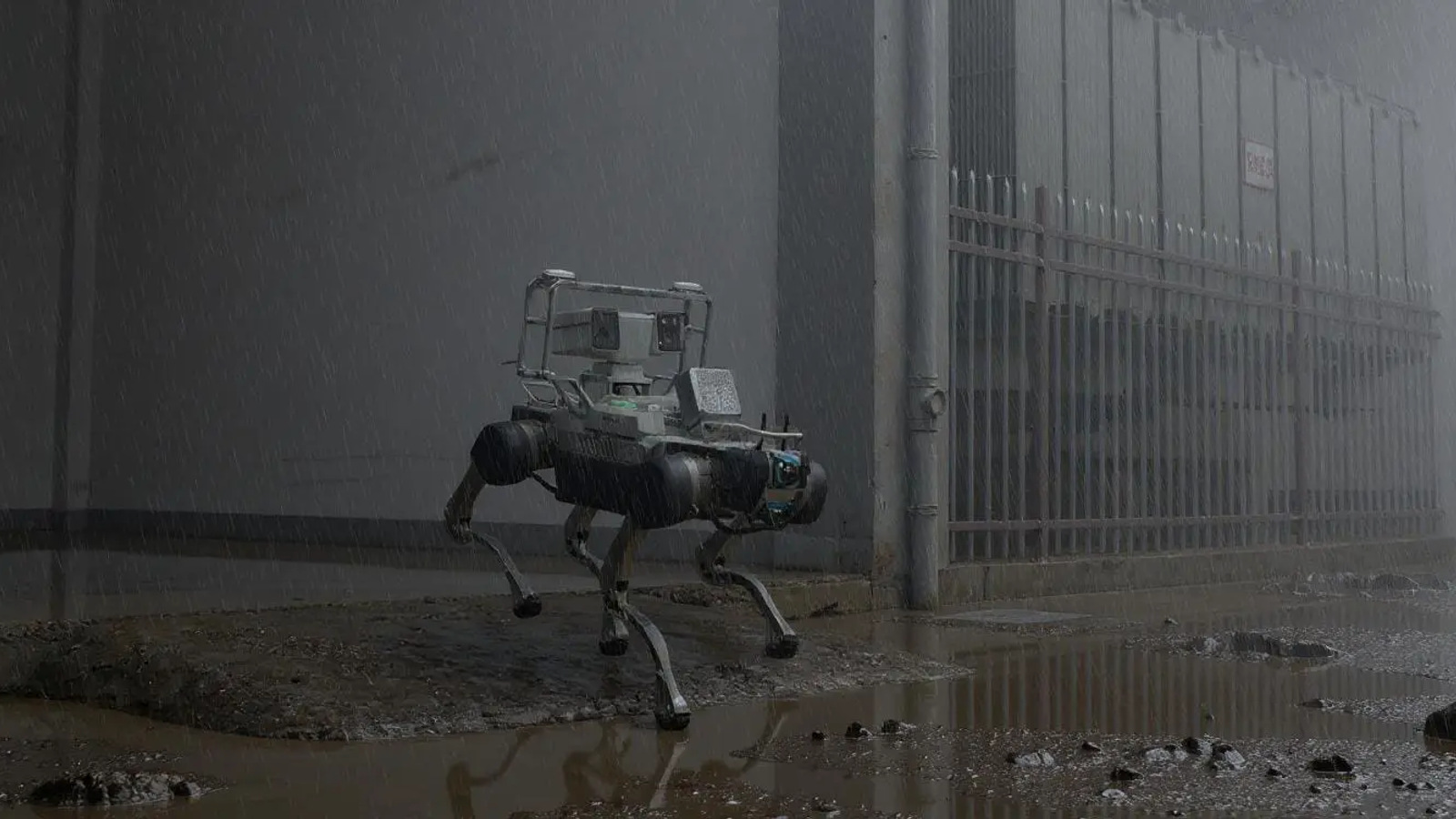
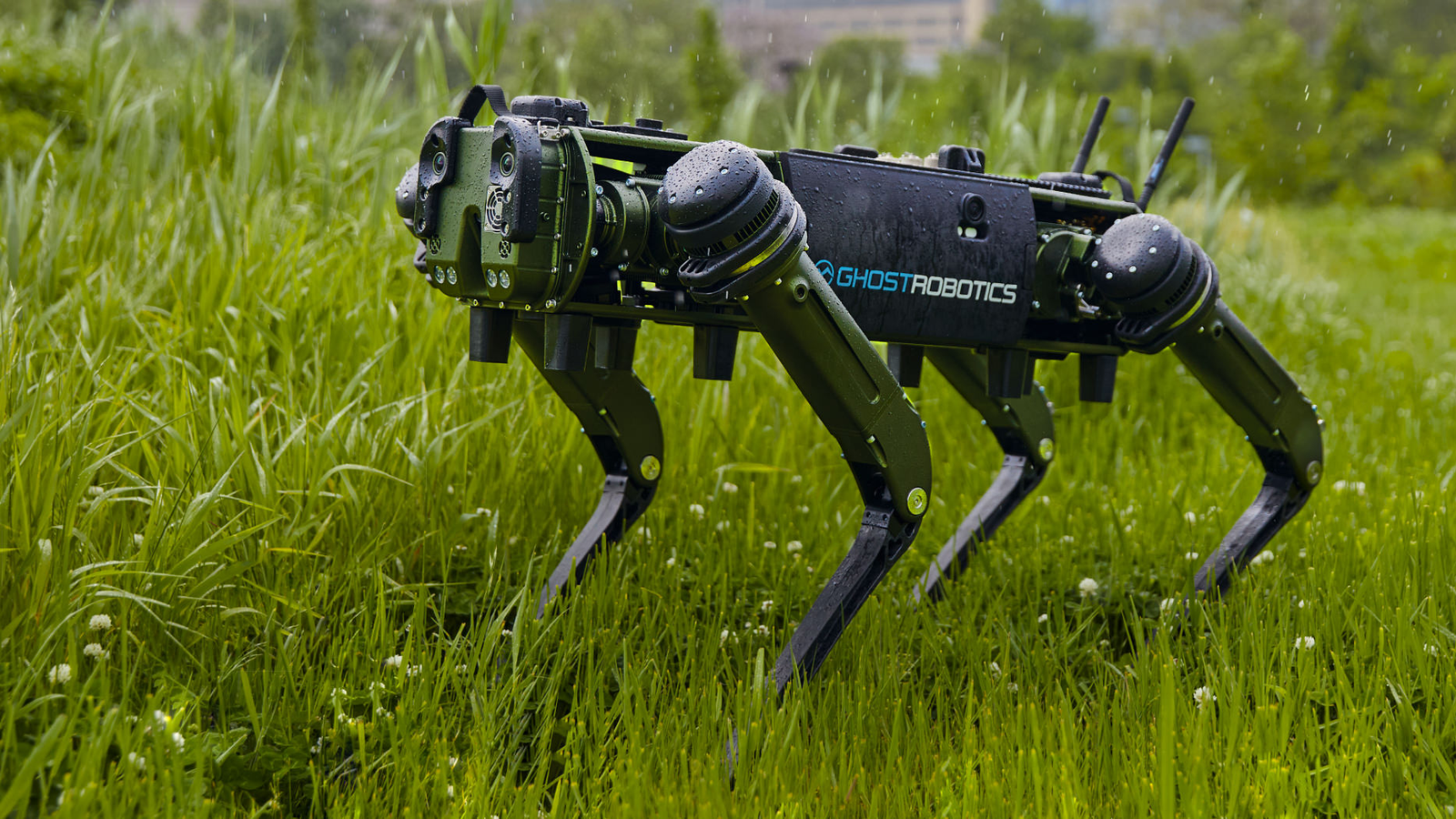
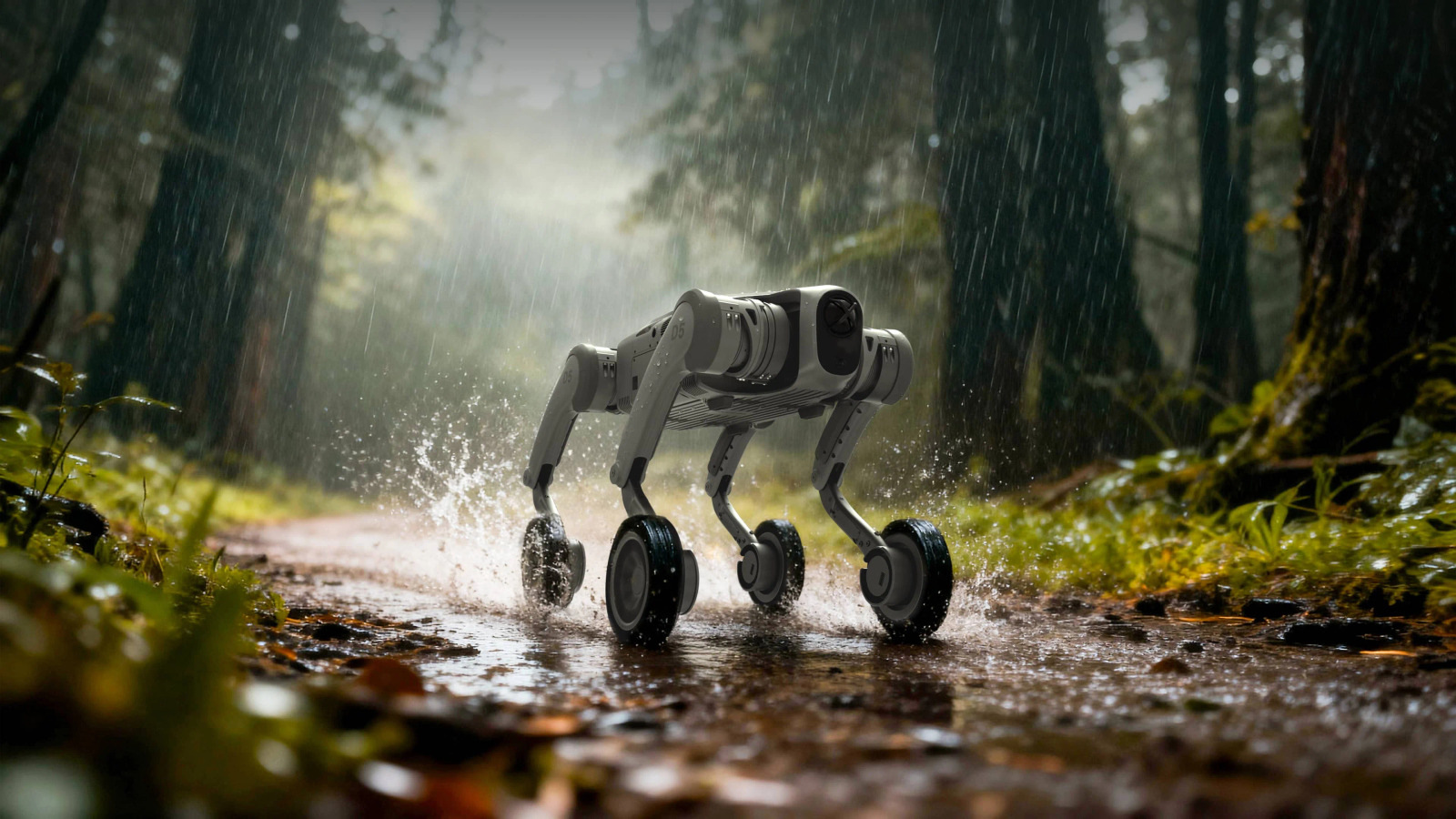
Four-legged robots combine mobile perception with joint control to move over uneven ground. Inspection platforms, research robots and wheeled quadrupeds share much of their component stack, with different demands on payload, weather protection and sustained operation.
Each MEVIUS2 leg has a lateral hip joint, a forward-swing hip joint and a knee. Motors, reduction gears, bearings and encoders turn electrical power into controlled leg motion.
Support rotating parts and carry loads while allowing the joint to move.
A parallel linkage transfers knee motion while keeping actuator mass nearer the body. The foot supplies a compliant contact surface.
The same component stack, another load path
The rear legs use the same three-joint arrangement. Coordinated joint torque supports the body and shifts contact between feet. The gait depends on control and feedback as well as the mechanism.
Carry loads between joints, hold components in alignment and protect electronics.
Foot impacts travel through the links and joint supports into the body. Motor heating, transmission loads and contact grip limit sustained motion.
Structure, sensing and power
The body carries the battery, control electronics and perception hardware. MEVIUS2 uses two Livox MID-360 LiDARs and a TIER IV C1 camera. Their observations support localisation and navigation.
Stores energy in cells, with monitoring, protection and connections to the power system.
Its aluminium structure combines machined A7075 parts with A5052 sheet fabrication. Cameras, LiDAR, computing and power remain distinct component layers.
About this reference
MEVIUS2 is a research design published in March 2026. The display uses its original meshes and joint frames. It is one architecture, alongside commercial robots with different transmissions, sensors and enclosure designs.
Quadrupeds shipped in H1 2026, estimated by Counterpoint. Industrial applications accounted for 40%.
Industrial 40%Other applications 60%
2026 outlook & evidence
Counterpoint forecasts 90,000+ shipments and US$1.5bn industry revenue for full-year 2026, including supporting hardware and software. These are forecasts.
The shipment estimate excludes small entry-level robots designed exclusively as children’s companions.
Overall quadruped shipments. Other vendors is the calculated remainder after the three named shares. AGIQUAD leads industrial shipments; Genisom’s M series exceeded 1,000 shipments in the period.
IDC separately estimates more than 49,000 quadrupeds shipped in H1 2026 and over US$400 million in market revenue. Its industry applications contributed over two-thirds of revenue from under 40% of units. These are separate publisher estimates. IDC · H1 2026 →
Unitree
23,037
quadrupeds sold in 2025
20233,121
20247,136
202523,037
Annual sales rose from 7,136 in 2024.
Source & scope
Unitree’s prospectus records 3,121 quadrupeds sold in 2023, 7,136 in 2024 and 23,037 in 2025. These are annual sales, separate from production counts and Counterpoint’s shipment estimates.
Lens reports an exclusive complete-machine assembly order from DOBOT, alongside joint motors and structural components.
Source & scope
Order volume disclosed in Lens Technology’s 2025 annual report, published 28 April 2026. The passage does not confirm delivery of all 10,000 units or their final customer sales.