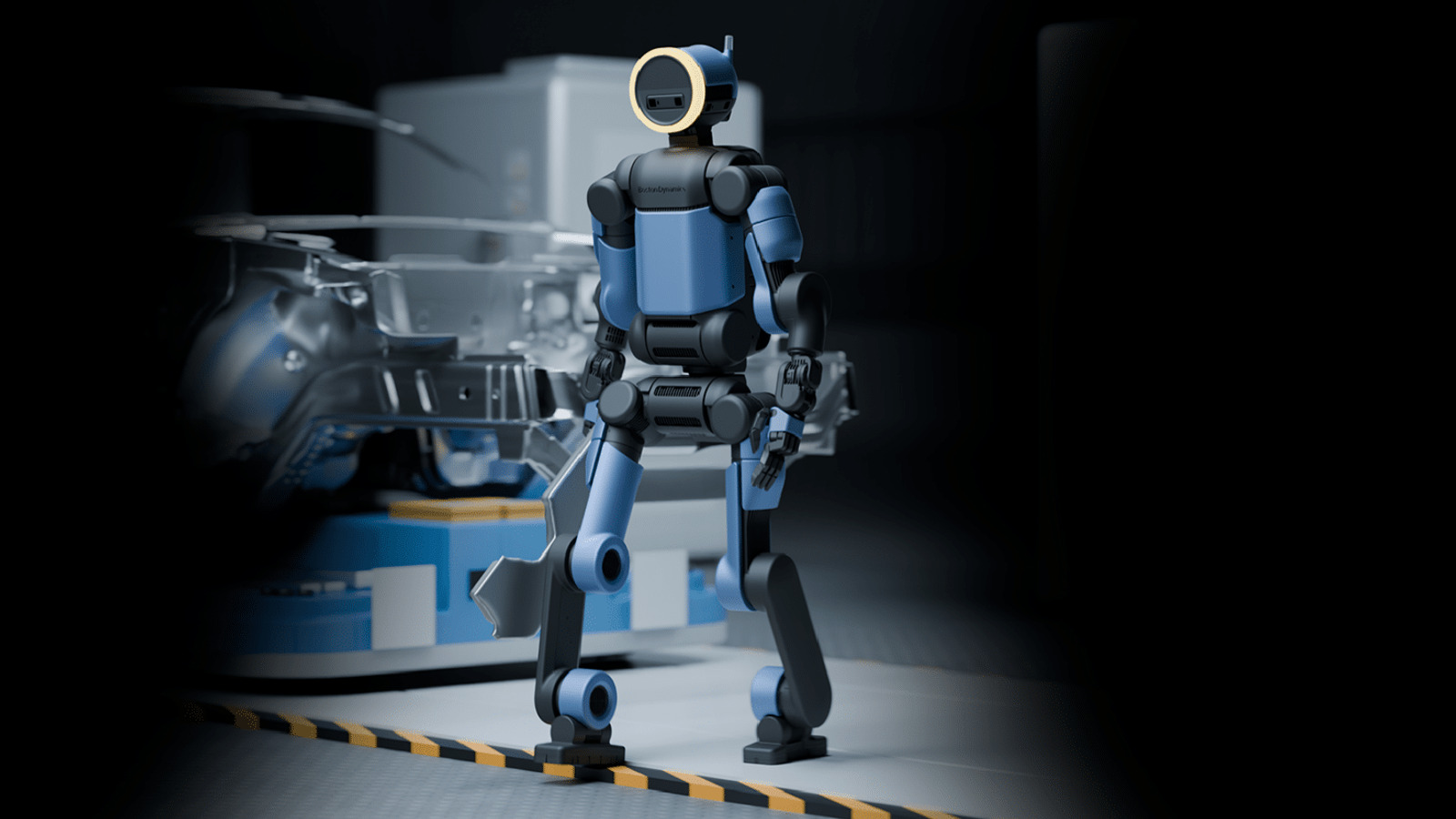
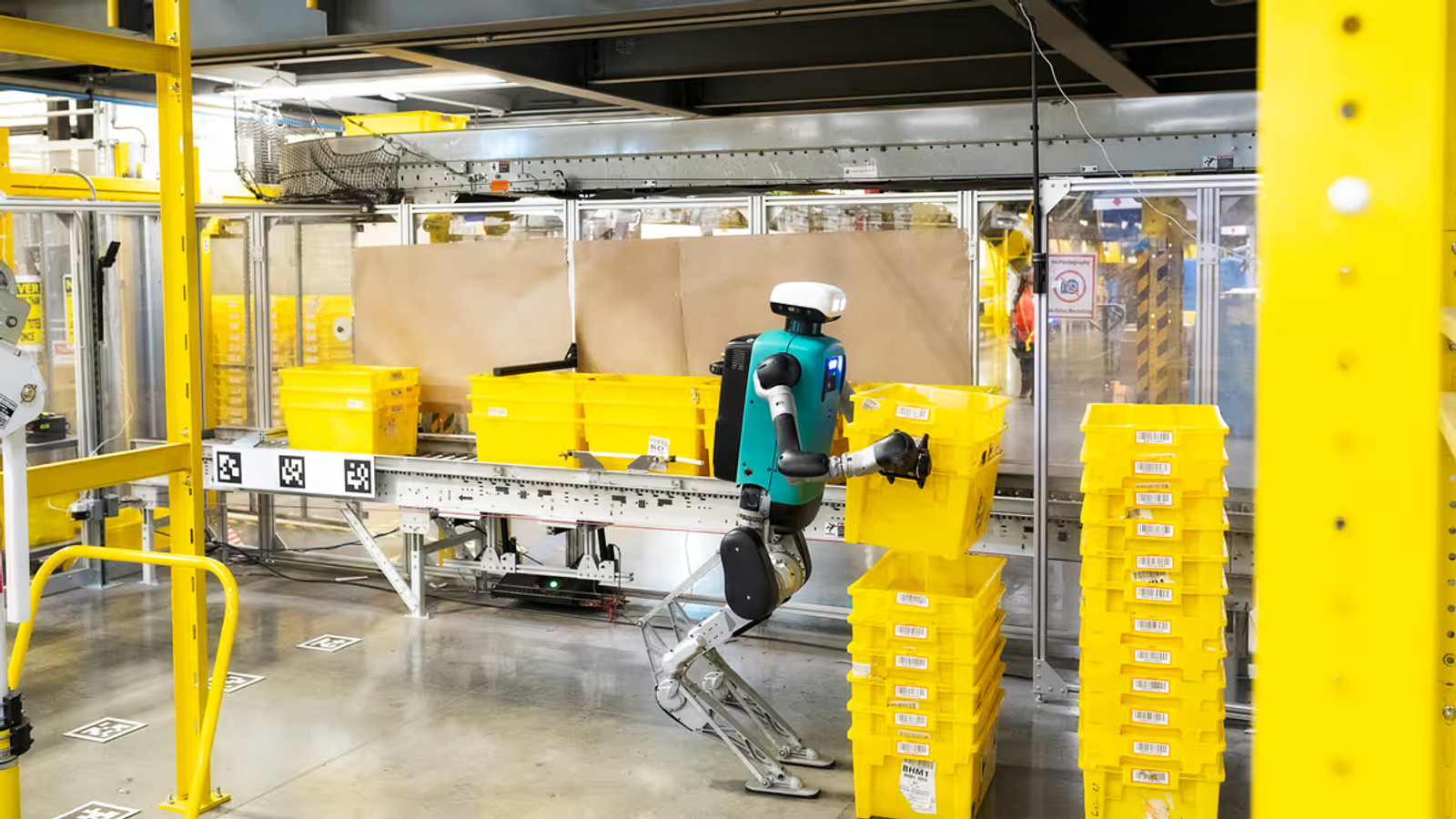
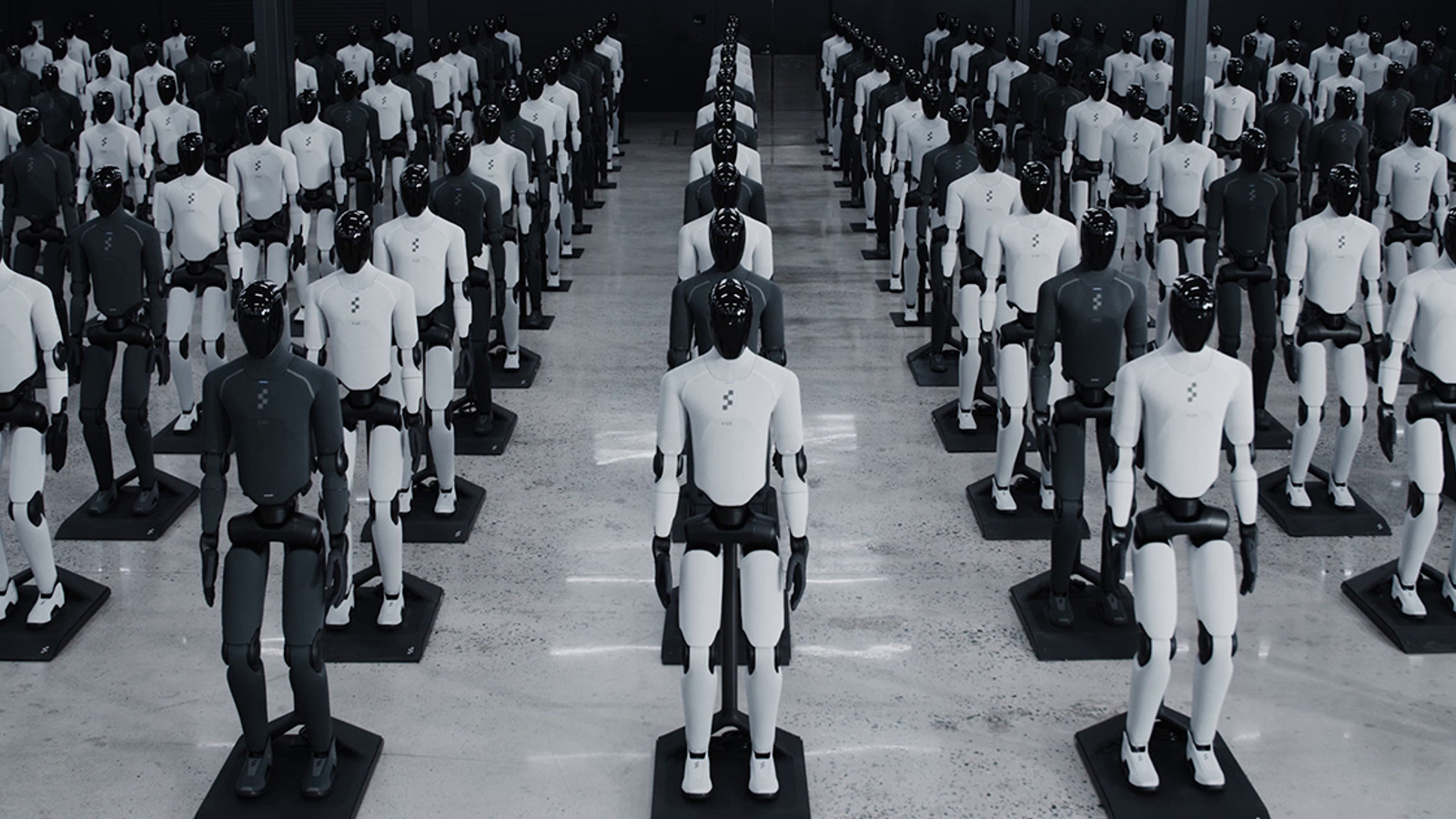
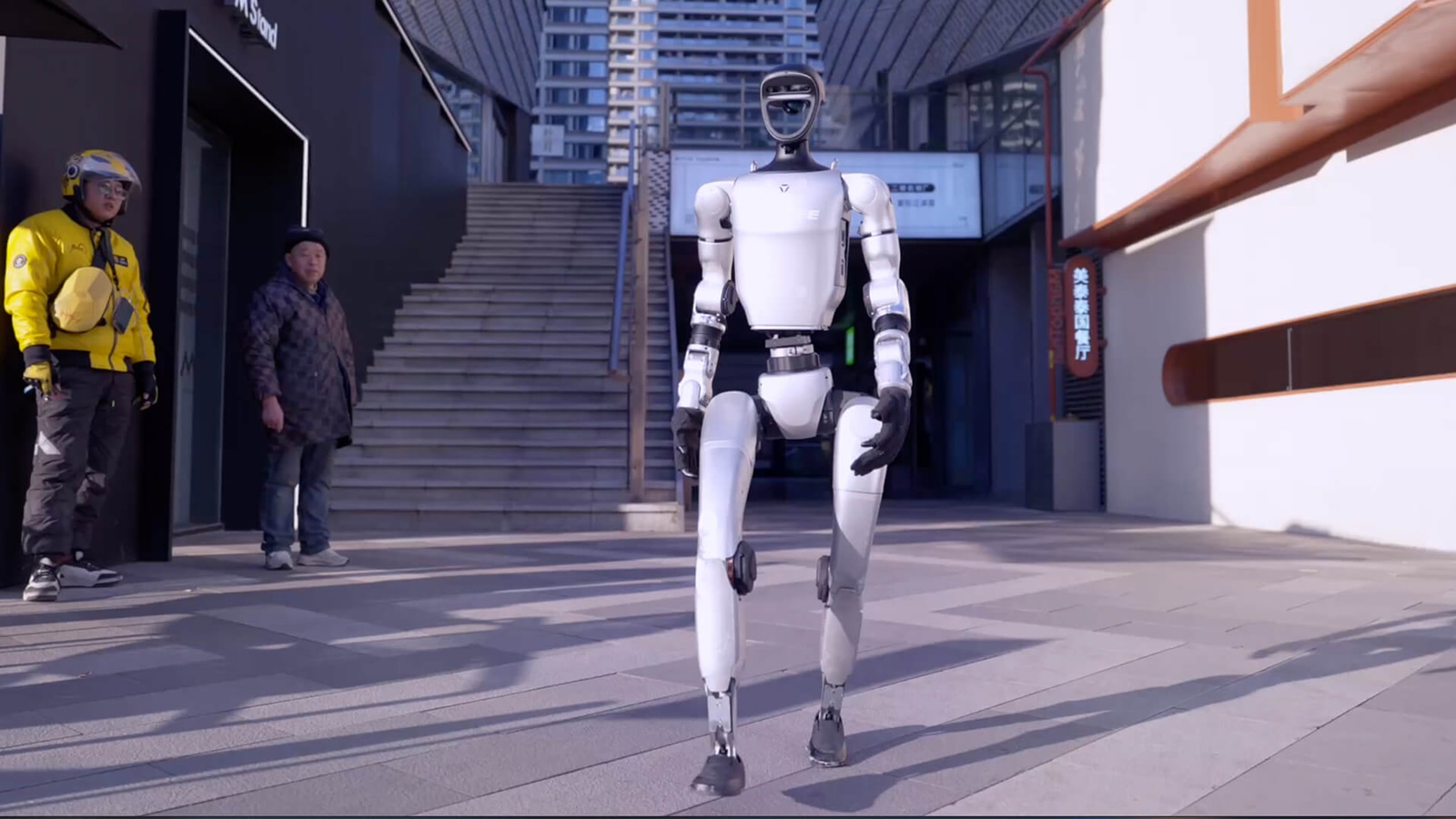
Robots with human-like bodies bring perception, manipulation and whole-body control into one system. Explore the components behind them, the companies supplying them and the evidence of production and scale.
Turns sensor observations into motion commands. Joint drives regulate the motors.
In this model · ROBOTO Origin V2The V2 model contains no separate head or neck link. Head articulation is not represented.
Perception and head compute
Documented camera
2 MP monocular
Head computer
Raspberry Pi 5
The Pi 5 handles media, networking and edge services. Time-sensitive locomotion control runs on the torso’s Radxa CM5.
Why the neck stays fixed Menlo documents 25 powered joints in the hardware. Its locomotion reference locks the two neck joints, leaving 23 articulated joints in this model.
Compare camera suppliers, depth-sensing architectures and perception-market consolidation. The D435 component view is a separate example, not Asimov’s installed camera.
Measures joint or motor angle so the controller can correct the movement.
In this model · ROBOTO Origin V2Five joints per arm provide shoulder pitch, roll and yaw, elbow flexion and forearm rotation. The end link does not include an articulated hand.
Left elbow
Bends the forearm relative to the upper arm.
Displayed model range
0° to 120°
OEM actuator model
EC-A4310-P2-36
OEM rated / peak torque
12 / 36 Nm
Actuator specifications: current Menlo documentation, checked 6 Oct 2026. Peak torque is short-duration; these are not measured viewer outputs.
Model / hardware difference Current hardware documentation gives 0 to 2.44 rad for this elbow; the displayed simulation stops at about 2.09 rad in magnitude.
Sources & motion scope
Signed model range: 0 to 2.0944 rad. Left and right axes use the source coordinate convention. Playback demonstrates a portion of the range; it does not validate collision clearance, balance or load capacity.
Actuator specifications: current Menlo documentation, checked 6 Oct 2026. Peak torque is short-duration; these are not measured viewer outputs.
Sources & motion scope
Signed model range: -3.141593 to 0.872665 rad. Left and right axes use the source coordinate convention. Playback demonstrates a portion of the range; it does not validate collision clearance, balance or load capacity.
Actuator specifications: current Menlo documentation, checked 6 Oct 2026. Peak torque is short-duration; these are not measured viewer outputs.
Sources & motion scope
Signed model range: -1.570796 to 0 rad. Left and right axes use the source coordinate convention. Playback demonstrates a portion of the range; it does not validate collision clearance, balance or load capacity.
Rotates the upper arm around the shoulder’s yaw axis.
Displayed model range
-90° to 90°
OEM actuator model
EC-A3814-H14-107
OEM rated / peak torque
20 / 60 Nm
Actuator specifications: current Menlo documentation, checked 6 Oct 2026. Peak torque is short-duration; these are not measured viewer outputs.
Sources & motion scope
Signed model range: -1.570796 to 1.570796 rad. Left and right axes use the source coordinate convention. Playback demonstrates a portion of the range; it does not validate collision clearance, balance or load capacity.
Actuator specifications: current Menlo documentation, checked 6 Oct 2026. Peak torque is short-duration; these are not measured viewer outputs.
Model / hardware difference Current hardware documentation gives −2.44 to 0 rad for this elbow; the displayed simulation stops at about 2.09 rad in magnitude.
Sources & motion scope
Signed model range: -2.0944 to 0 rad. Left and right axes use the source coordinate convention. Playback demonstrates a portion of the range; it does not validate collision clearance, balance or load capacity.
Actuator specifications: current Menlo documentation, checked 6 Oct 2026. Peak torque is short-duration; these are not measured viewer outputs.
Sources & motion scope
Signed model range: -0.872665 to 3.141593 rad. Left and right axes use the source coordinate convention. Playback demonstrates a portion of the range; it does not validate collision clearance, balance or load capacity.
Actuator specifications: current Menlo documentation, checked 6 Oct 2026. Peak torque is short-duration; these are not measured viewer outputs.
Sources & motion scope
Signed model range: 0 to 1.570796 rad. Left and right axes use the source coordinate convention. Playback demonstrates a portion of the range; it does not validate collision clearance, balance or load capacity.
Rotates the upper arm around the shoulder’s yaw axis.
Displayed model range
-90° to 90°
OEM actuator model
EC-A3814-H14-107
OEM rated / peak torque
20 / 60 Nm
Actuator specifications: current Menlo documentation, checked 6 Oct 2026. Peak torque is short-duration; these are not measured viewer outputs.
Sources & motion scope
Signed model range: -1.570796 to 1.570796 rad. Left and right axes use the source coordinate convention. Playback demonstrates a portion of the range; it does not validate collision clearance, balance or load capacity.
Measures pushes, pulls and twisting loads at a joint or contact interface.
In this model · ROBOTO Origin V2The V2 model stops at the arm end links. It contains no finger or wrist joints; hand mechanisms are covered separately in Components.
Left wrist yaw
Rotates the wrist end link; this reference contains no articulated fingers.
Displayed model range
-180° to 180°
OEM actuator model
EC-A4310-P2-36
OEM rated / peak torque
12 / 36 Nm
Actuator specifications: current Menlo documentation, checked 6 Oct 2026. Peak torque is short-duration; these are not measured viewer outputs.
Sources & motion scope
Signed model range: -3.141593 to 3.141593 rad. Left and right axes use the source coordinate convention. Playback demonstrates a portion of the range; it does not validate collision clearance, balance or load capacity.
Rotates the wrist end link; this reference contains no articulated fingers.
Displayed model range
-180° to 180°
OEM actuator model
EC-A4310-P2-36
OEM rated / peak torque
12 / 36 Nm
Actuator specifications: current Menlo documentation, checked 6 Oct 2026. Peak torque is short-duration; these are not measured viewer outputs.
Sources & motion scope
Signed model range: -3.141593 to 3.141593 rad. Left and right axes use the source coordinate convention. Playback demonstrates a portion of the range; it does not validate collision clearance, balance or load capacity.
Compare hand suppliers, manufacturing scale and durability constraints. These are options in the broader market; no hand is installed in this reference.
Computing turns sensor data into motion commands. Distributed drives control the motors, while the frame carries loads between the upper body and pelvis.
Carry loads between joints, hold components in alignment and protect electronics.
In this model · ROBOTO Origin V2A single torso joint rotates the upper body relative to the base. The display meshes do not separate the onboard electronics.
Waist yaw
Turns the upper body relative to the pelvis.
Displayed model range
-90° to 90°
OEM actuator model
EC-A6416-P2-25
OEM rated / peak torque
40 / 120 Nm
Actuator specifications: current Menlo documentation, checked 6 Oct 2026. Peak torque is short-duration; these are not measured viewer outputs.
Sources & motion scope
Signed model range: -1.570796 to 1.570796 rad. Left and right axes use the source coordinate convention. Playback demonstrates a portion of the range; it does not validate collision clearance, balance or load capacity.
Support rotating parts and carry loads while allowing the joint to move.
In this model · ROBOTO Origin V2Each leg has six joints. The first two hip axes are inclined relative to the body axes; the published limits differ between left and right. This shows an alternative arrangement of the hip joints.
Left ankle pitch
Tilts the foot forward and backward through the ankle mechanism.
Displayed model range
-20.1° to 20.1°
OEM ankle architecture
Coupled A/B actuators
The displayed pitch and roll axes are joint-space coordinates. Menlo’s physical A/B actuator ratings cannot be treated as independent pitch/roll output torque.
Sources & motion scope
Signed model range: -0.35 to 0.35 rad. Left and right axes use the source coordinate convention. Playback demonstrates a portion of the range; it does not validate collision clearance, balance or load capacity.
Tilts the foot sideways through the ankle mechanism.
Displayed model range
-5.7° to 5.7°
OEM ankle architecture
Coupled A/B actuators
The displayed pitch and roll axes are joint-space coordinates. Menlo’s physical A/B actuator ratings cannot be treated as independent pitch/roll output torque.
Sources & motion scope
Signed model range: -0.1 to 0.1 rad. Left and right axes use the source coordinate convention. Playback demonstrates a portion of the range; it does not validate collision clearance, balance or load capacity.
Moves the leg forward and backward relative to the pelvis.
Displayed model range
-90° to 90°
OEM actuator model
EC-A6416-P2-25
OEM rated / peak torque
40 / 120 Nm
Actuator specifications: current Menlo documentation, checked 6 Oct 2026. Peak torque is short-duration; these are not measured viewer outputs.
Model / hardware difference Current hardware documentation gives −2.09 to 1.00 rad for this hip; the displayed simulation uses −1.57 to 1.57 rad.
Sources & motion scope
Signed model range: -1.57 to 1.57 rad. Left and right axes use the source coordinate convention. Playback demonstrates a portion of the range; it does not validate collision clearance, balance or load capacity.
Actuator specifications: current Menlo documentation, checked 6 Oct 2026. Peak torque is short-duration; these are not measured viewer outputs.
Sources & motion scope
Signed model range: -0.785398 to 0.785398 rad. Left and right axes use the source coordinate convention. Playback demonstrates a portion of the range; it does not validate collision clearance, balance or load capacity.
Actuator specifications: current Menlo documentation, checked 6 Oct 2026. Peak torque is short-duration; these are not measured viewer outputs.
Sources & motion scope
Signed model range: -0.785398 to 0.785398 rad. Left and right axes use the source coordinate convention. Playback demonstrates a portion of the range; it does not validate collision clearance, balance or load capacity.
Bends the leg between its upper and lower segments.
Displayed model range
0° to 85.9°
OEM actuator model
EC-A4315-P2-36
OEM rated / peak torque
25 / 75 Nm
Actuator specifications: current Menlo documentation, checked 6 Oct 2026. Peak torque is short-duration; these are not measured viewer outputs.
Sources & motion scope
Signed model range: 0 to 1.5 rad. Left and right axes use the source coordinate convention. Playback demonstrates a portion of the range; it does not validate collision clearance, balance or load capacity.
Tilts the foot forward and backward through the ankle mechanism.
Displayed model range
-20.1° to 20.1°
OEM ankle architecture
Coupled A/B actuators
The displayed pitch and roll axes are joint-space coordinates. Menlo’s physical A/B actuator ratings cannot be treated as independent pitch/roll output torque.
Sources & motion scope
Signed model range: -0.35 to 0.35 rad. Left and right axes use the source coordinate convention. Playback demonstrates a portion of the range; it does not validate collision clearance, balance or load capacity.
Tilts the foot sideways through the ankle mechanism.
Displayed model range
-5.7° to 5.7°
OEM ankle architecture
Coupled A/B actuators
The displayed pitch and roll axes are joint-space coordinates. Menlo’s physical A/B actuator ratings cannot be treated as independent pitch/roll output torque.
Sources & motion scope
Signed model range: -0.1 to 0.1 rad. Left and right axes use the source coordinate convention. Playback demonstrates a portion of the range; it does not validate collision clearance, balance or load capacity.
Moves the leg forward and backward relative to the pelvis.
Displayed model range
-90° to 90°
OEM actuator model
EC-A6416-P2-25
OEM rated / peak torque
40 / 120 Nm
Actuator specifications: current Menlo documentation, checked 6 Oct 2026. Peak torque is short-duration; these are not measured viewer outputs.
Model / hardware difference Current hardware documentation gives −1.00 to 2.09 rad for this hip; the displayed simulation uses −1.57 to 1.57 rad.
Sources & motion scope
Signed model range: -1.57 to 1.57 rad. Left and right axes use the source coordinate convention. Playback demonstrates a portion of the range; it does not validate collision clearance, balance or load capacity.
Actuator specifications: current Menlo documentation, checked 6 Oct 2026. Peak torque is short-duration; these are not measured viewer outputs.
Sources & motion scope
Signed model range: -0.785398 to 0.785398 rad. Left and right axes use the source coordinate convention. Playback demonstrates a portion of the range; it does not validate collision clearance, balance or load capacity.
Actuator specifications: current Menlo documentation, checked 6 Oct 2026. Peak torque is short-duration; these are not measured viewer outputs.
Sources & motion scope
Signed model range: -0.785398 to 0.785398 rad. Left and right axes use the source coordinate convention. Playback demonstrates a portion of the range; it does not validate collision clearance, balance or load capacity.
Bends the leg between its upper and lower segments.
Displayed model range
-85.9° to 0°
OEM actuator model
EC-A4315-P2-36
OEM rated / peak torque
25 / 75 Nm
Actuator specifications: current Menlo documentation, checked 6 Oct 2026. Peak torque is short-duration; these are not measured viewer outputs.
Sources & motion scope
Signed model range: -1.5 to 0 rad. Left and right axes use the source coordinate convention. Playback demonstrates a portion of the range; it does not validate collision clearance, balance or load capacity.
Explore joint suppliers and scaling constraints. Rotary and linear architectures are alternatives; a linear-drive example does not establish Asimov adoption.
Creates rotation. A frameless motor fits directly inside the joint housing.
Power distribution
Routes power to motor drives, computing and sensors. Peak motor demand and total stored energy are different constraints.
In this model · ROBOTO Origin V2No separate battery link is identified in the V2 model. Battery packaging and power electronics cannot be inspected as separate parts here.
Battery and distribution
Nominal pack voltage
46.8 V
Documented energy
491.4 Wh
Pack arrangement
13S4P lithium-ion
Series cells establish pack voltage; parallel cells add capacity. The pack feeds the power-distribution board and actuator power network.
Current OEM hardware specification; the reference geometry does not expose a separate battery. Energy alone does not establish operating runtime.
Asimov’s documented architecture, simplified. Select a system to inspect it.
Power
→→
Control
↔↔
The head and torso computers communicate over Ethernet. Actuator branches carry power and CAN; this schematic does not assign physical branches to controller bus numbers.
Menlo Research’s Asimov 1 geometry and joint definitions. This pinned locomotion model has 23 articulated joints, including the wrists, but no hands. Menlo’s current hardware documentation describes 25 powered joints; the two neck joints are locked in the locomotion reference.
RoboParty’s ROBOTO Origin V2 geometry and joint definitions. The reference has five joints per arm, six per leg and one torso joint, with no separate head or articulated hands.
Movement follows the reference joint axes and limits. Balance and ground contact are not simulated.
Market context
Global production · 2025
20,000+
Humanoid robots produced worldwide, estimated by Interact Analysis. Output was below 2,000 in 2024.
Source & scope
Research estimate published 11 June 2026. Production counts robots built, across their intended applications; it does not measure commercial use. The analyst’s total is separate from the individual company disclosures below.
Unitree and AgiBot together exceeded 11,000 units, accounting for more than half of global output.
Source & scope
Both shares use Interact Analysis’s 2025 global production estimate. The five largest producers were all Chinese; these groups overlap and their shares are not added together.
Counterpoint estimates shipments grew nearly 300% year on year. Entertainment, performance, data collection and research still accounted for more than 60%.
Estimates & scope
Counterpoint’s August 2026 release measures shipments, separate from Interact Analysis’s 2025 production series. Its forecast of more than 50,000 shipments for full-year 2026 is forward-looking.
A separate IDC estimate, cited by AgiBot on 30 September, puts H1 shipments near 25,000. The analyst totals use separate research series and are not combined or averaged.
Share of robots produced that Interact Analysis says reached real-world applications. Most such projects remained small pilots or proofs of concept.
Source & scope
This is the analyst’s application classification for 2025, not a measure of autonomous working hours, profitable installations or sustained commercial use. Production growth alone does not establish deployment at scale.
Indicative share of humanoid hardware bill of materials. Actuation includes motors, transmissions, joint assemblies and integrated sensing and drive electronics.
The split varies with robot design, production volume and whether hands are costed separately.
Sources & scope
McKinsey reports the 40–60% range. Schaeffler provides a supplier assessment; Interact Analysis distinguishes configurations; BofA’s 51% is a 2030 hardware BOM forecast.
Joint actuators exceed 30% of BOM in high-configuration robots with dexterous hands and advanced sensors; some basic versions exceed 50%. The estimates cover different robot configurations.
Projected 2030 BOM: linear actuators 27% plus rotary actuators 24%, totalling 51%. Dexterous hands are a separate 19% category.
Digit 5 BOM targets at scale
≈$75k → ≈$30k
Agility targets hardware BOM of about US$75,000 per robot at 1,000 units/year, falling to about US$30,000 at 10,000 units/year. Launch BOM is estimated at about US$150,000.
Company-specific reference point, not an industry-wide cost benchmark.
Source & assumptions
Agility’s 6 October 2026 investor presentation, slides 57–58. Values are approximate readings of the company’s illustrative cost curve. Production volumes are annual scenarios, and the reductions are forward-looking targets. BOM covers hardware parts, separate from selling price and operating cost.
Reported quantities first, followed by milestones, estimates and historical disclosures. Each row identifies production, shipments, deliveries or sales.
CompanyDisclosed figureRecord typeDisclosedSource
AgiBot20,000 humanoid robots produced cumulativelyCumulative production24 Sept 2026Company-reported
AgiBot describes the robot delivered to Chimelong on 24 September 2026 as its 20,000th humanoid off the production line. This is cumulative production across models; the bipedal and wheeled breakdown is not disclosed.
Lingyi iTechMore than 5,000 humanoid robots assembledProduction status4 Sept 2026Company-reported
Lingyi iTech states that it has completed assembly of more than 5,000 humanoid robots.
UBTECH Robotics921 full-size humanoid units sold in H1 2026Reported sales28 Aug 2026Filing-reported
UBTECH reported 921 full-size embodied intelligent humanoid units sold in H1 2026. This is a portfolio sales measure; the filing describes both wheeled and bipedal products and does not allocate the total to individual models. Sales do not establish units produced, shipped, installed or in active operation.
Period: six months ended June 30, 2026
Unitreeapproximately 18,000 bionic bipedal humanoids produced cumulativelyCumulative production12 Aug 2026Company-reported
Unitree reported approximately 18,000 bionic bipedal humanoid robots produced and offline cumulatively. The scope explicitly excludes other humanoid types and wheeled humanoid platforms.
Figure founder Brett Adcock reported that BotQ manufactured its 1,000th complete humanoid robot for the F.03 programme. This is cumulative produced-unit output, not a component count, delivery count or annual production rate.
Figure says BotQ delivered over 350 Figure 03 humanoid robots by April 29, 2026. The number is a company-disclosed cumulative delivery figure, not a separately verified produced-unit count.
AgiBotabout 5,000 additional robots in three monthsOutput over a stated period30 Mar 2026Company-reported
AGIBOT said the jump from 5,000 to 10,000 humanoid robots was completed in just three months, representing roughly 5,000 additional units over that interval. The period output is a company-disclosed ramp metric, not a steady-state monthly production rate.
Period: roughly three months ending Mar 30, 2026
Booster Roboticsover 700 humanoid robots shipped globallyReported shipments30 Oct 2025Company-reported
Booster Robotics said it had shipped over 700 humanoid robots globally, serving more than 200 clients across over 20 countries and more than 70 universities and research institutions.
Booster RoboticsBooster T1more than 50 Booster T1 units shippedReported shipments23 Jan 2025Company-reported
Booster Robotics said Booster T1 had reached mass production and global shipment, with more than 50 units shipped within three months of launch.
Menlo ResearchAsimov 1Commercial orders and worldwide shippingShipping status12 Sept 2026Company-reported
Menlo Research accepts orders for Asimov 1, states that it ships worldwide and says units are already working in laboratories and workshops.
Period: ships summer 2026 guidance
Kepler RoboticsK2 Bumblebeemass production and customer shipments startedProduction status26 Sept 2025Company-reported
Kepler Robotics announced that K2 Bumblebee had started mass production and begun shipping to customers, but the release did not disclose a unit count.
Period: announced Sep 26, 2025
RobrosIGRIS-CDelivery to first customer, RobotableDelivery milestone26 Sept 2025Company-reported
Robros announced delivery of IGRIS-C to its first customer, Robotable, for exhibition at Gyeongnam Robot Land. The announcement does not disclose a shipment quantity.
DobotAtomglobal mass production and delivery startedReported shipments27 Jun 2025Company-reported
DOBOT debuted global mass production and delivery of its Atom humanoid robot at a Nagoya launch event.
Fourier IntelligenceGR-1Described by Fourier as its first mass-produced humanoidProduction status31 Dec 2023Company-reported
Fourier records GR-1 as its first mass-produced humanoid. The statement is a company maturity description, not a unit-output or delivery count.
Forbes reported that Galaxea had begun shipping R1 humanoid robots. Forward-looking unit targets from the article are not counted here.
AgiBotMore than 8,600 shipments in H1 2026Historical disclosureEstimated shipments30 Sept 2026IDC estimate · company cited
Historical disclosure retained for context; it does not establish current capacity or output.
AGIBOT cited IDC estimates of more than 8,600 humanoid shipments in January–June 2026; these are shipments, not deployed fleets.
Period: H1 2026
Unitree5,716 humanoid robots produced in 2025 (filing)Historical disclosureProduction output31 Jul 2026Filing-reported
Historical disclosure retained for context; it does not establish current capacity or output.
Unitree’s July 2026 prospectus reports 5,716 humanoid robots produced in 2025. This differs from the earlier company press release’s production total; the reviewed filing passage does not reconcile the difference. The filing figure is retained as a separate disclosure, without assuming the reporting scopes are identical.
Period: 2025
Unitree5,215 humanoid robots sold in 2025 (filing)Historical disclosureReported sales31 Jul 2026Filing-reported
Historical disclosure retained for context; it does not establish current capacity or output.
Unitree’s July 2026 prospectus reports 5,215 humanoid robots sold in 2025. This is the filing’s recognised-sales measure, separate from its shipment and production totals. The figure does not establish an installed fleet or active commercial deployments.
Historical disclosure retained for context; it does not establish current capacity or output.
Unitree’s July 2026 prospectus reports 5,511 humanoid robots shipped in 2025. The filing distinguishes dispatch under customer orders or contracts from recognised sales: some shipped units had not completed receipt, acceptance or other revenue-recognition procedures by year-end.
Period: 2025
ENGINEAIPM01hundreds of PM01 units in 2025Historical disclosureProduction output29 May 2026Company-reported
Historical disclosure retained for context; it does not establish current capacity or output.
EngineAI said it moved from a first test machine in 2024 to small-scale production of hundreds of PM01 units in 2025 before the T800 manufacturing-base launch. The wording is approximate, so it is not ranked against exact output rows.
Period: 2025
UBTECH RoboticsWalker S21,000-unit-level production and delivery milestoneHistorical disclosureReported shipments21 Apr 2026Filing-reported
Historical disclosure retained for context; it does not establish current capacity or output.
UBTECH filing language says the 1,000-unit-level small-scale mass production and delivery of Walker S2 marked maturity and stability of its manufacturing process. Korthos treats this as a filing-disclosed scale milestone, not audited installed base.
Period: through 2025
No records match these filters.
Stated capacity first, then planned capacity and output targets. Past targets appear last; annual capacity and completed output are separate measures.
CompanyDisclosed figureRecord typeDisclosedSource
DAX RoboticsX7 Pro · Wheeled humanoid1,000 units/yearStated capacity23 Jun 2026Third-party report
DAX Robotics' existing production line was reported as capable of producing 1,000 units per year.
Period: annual capacity
Agility RoboticsDigitup to 10,000 robots/year design capacityPlanned capacity15 Sept 2026Company-reported
Agility says RoboFab is designed to produce up to 10,000 Digit robots per year at full capacity. This is the facility's design capacity, not achieved annual output or current utilisation.
UBTECH RoboticsWalker S seriesMore than 10,000 robots/year planned capacityPlanned capacity12 Sept 2026Third-party report
UBTECH’s commissioned Liuzhou Super Smart Factory has planned annual capacity above 10,000 Walker S-series industrial humanoid robots; the production line is designed for one completed robot every 10 minutes.
Period: from commissioning on September 12, 2026
Holiday RoboticsFRIDAY · Wheeled humanoid100 units/year production system in 2026Planned capacity13 Jul 2026Third-party report
Holiday Robotics said it is preparing a 100-unit annual FRIDAY production system in 2026 as part of H2 2026 commercialization planning.
Period: 2026
1X TechnologiesNEOup to 10,000 robots/yearPlanned capacity30 Apr 2026Company-reported
1X says its Hayward NEO Factory is live and, with San Carlos coming online later in 2026, the company has capacity to produce up to 10,000 robots per year. This is stated capacity rather than confirmed annual output.
Period: 2026 stated capacity
Leju RoboticsKUAVO Seriesover 10,000 robots/yearPlanned capacity29 Mar 2026Company-reported
Dongfang Precision's official account said it and Leju launched a Guangdong humanoid production line with annual capacity above 10,000 units. The figure is stated line capacity, not confirmed annual output.
Period: launched Mar 29, 2026
Figure AIFigure 03up to 12,000 robots/yearPlanned capacity15 Mar 2025Company-reported
Figure says BotQ is a high-volume manufacturing facility whose first-generation line is capable of manufacturing up to 12,000 humanoids per year. The figure is stated line capacity, not confirmed annual output.
In a Relentless interview published on 18 September 2026, 1X CEO Bernt Børnich outlined a target to manufacture and ship 50,000 NEO home robots in 2027.
Period: 2027
AgiBotmore than 5,000 robots/yearCapacity target29 Aug 2026Third-party report
Serbian officials said the Šabac facility is intended to assemble more than 5,000 robots annually in its initial phase; this is a target, not reported output.
Holiday Robotics said it plans to secure 1,000 units/year annual FRIDAY production capacity in 2027 to expand humanoid supply across manufacturing.
Period: 2027
DAX RoboticsX7 Pro · Wheeled humanoid10,000 units/year targetCapacity target23 Jun 2026Third-party report
DAX Robotics plans to expand its production line toward annual capacity of 10,000 units.
Period: target annual capacity
Neura Roboticstens of thousands of humanoids/yearCapacity target10 Jun 2026Company-reported
NEURA Robotics’ short-term plan described humanoid production capacity rising from 6,000 units in 2026 to “tens of thousands” in 2027. The 2027 figure is imprecise and remains out of public comparison ranking.
Period: 2027
Neura Robotics4NE16,000 humanoids/yearCapacity target10 Jun 2026Company-reported
NEURA Robotics’ short-term humanoid production-capacity target was 6,000 units in 2026. The figure is a company target for humanoid capacity, not confirmed annual output.
1X says planned automation increases and the San Carlos facility are expected to scale production toward 100,000-plus robots annually by the end of 2027. This is a forward target, not current installed capacity.
Period: target by end of 2027
TeslaOptimus10 million Optimus robots/year long-term targetCapacity target22 Apr 2026Company-reported
Tesla showed Gigafactory Texas Optimus factory preparation and described a second-generation line designed for long-term annual production capacity of 10 million robots. Korthos keeps this long-term target out of disclosed-pool share comparisons.
Period: long-term target; out of pool share
Unitree75,000 robots/yearCapacity target23 Mar 2026Filing-reported
China Daily reported that Unitree's prospectus-backed intelligent manufacturing base project is designed to deliver annual output of 75,000 humanoid robots and 115,000 quadruped robots. The humanoid figure is a planned capacity target, not current annual output. This prospectus/media-reported capacity row is kept out of ranked compare pools until a direct company or filing disclosure is available.
Period: prospectus project reported Mar 23, 2026
XPeng Inc.IRONmore than 1,000 robots/month by end-2026Capacity target20 Mar 2026Company-reported
XPeng targets IRON monthly production capacity above 1,000 robots by the end of 2026. Annualized, the disclosed floor is above 12,000 robots per year; this is a capacity target, not achieved output.
Period: annualized target by 2026-12-31
Unitree10,000-20,000 humanoid robots targeted in 2026Annual shipment target17 Feb 2026Company-reported
CnTechPost reported that Unitree founder Wang Xingxing said Unitree was targeting 10,000 to 20,000 humanoid robot shipments in 2026. This is a forward-looking target, separate from Unitree's official 2025 produced and shipped disclosures.
Period: 2026 target
TeslaOptimus1 million Optimus robots/yearCapacity target28 Jan 2026Company-reported
Tesla said Optimus production was planned before the end of 2026 and described eventual planned capacity of 1 million robots per year at the Fremont facility.
Period: planned before end of 2026
Boston DynamicsAtlas30,000 robots/yearCapacity target5 Jan 2026Company-reported
Hyundai Motor Group said it aims to establish a scalable production system capable of manufacturing 30,000 robot units annually by 2028 for Atlas deployment across industrial sites.
Period: target by 2028
UBTECH RoboticsWalker S210,000 robots/yearCapacity target17 Nov 2025Company-reported
UBTECH said its Walker S2 ramp-up plan scales to 10,000 industrial humanoid units by 2027. This is a forward target and should be compared separately from reported output.
Period: target by 2027
TeslaOptimusroughly 120,000 robots/year next line designHistorical disclosureCapacity target29 Jan 2025Company-reported
Historical disclosure retained for context; it does not establish current capacity or output.
Musk described the next Optimus line as being on the order of 10,000 units per month, equivalent to about 120,000 robots per year if annualized.
Period: 10,000 robots/month annualized
TeslaOptimusroughly 12,000 robots/year line designHistorical disclosurePlanned capacity29 Jan 2025Company-reported
Historical disclosure retained for context; it does not establish current capacity or output.
Musk said the current Optimus production line being designed was for roughly 1,000 units per month, equivalent to about 12,000 robots per year if annualized.
Period: 1,000 robots/month annualized
UBTECH RoboticsWalker S2500 robots targeted for delivery in 2025Past targetAnnual shipment target17 Nov 2025Company-reported
Target period ended 2025-12-31. This disclosure does not establish whether the target was achieved.
UBTECH said Walker S2 mass production and delivery had begun and that the milestone moved the company toward a target of delivering 500 units within 2025. This is a delivery target, not confirmed delivered units.
Period: 2025 target deliveries
TeslaOptimusroughly 10,000 Optimus robots targeted in 2025Past targetAnnual production target29 Jan 2025Company-reported
Target period ended 2025-12-31. This disclosure does not establish whether the target was achieved.
Musk told investors Tesla was aiming for roughly 10,000 Optimus robots built in 2025, while acknowledging the exact target might not be hit and that several thousand was the more practical near-term expectation.
Period: 2025 target output
Fourier IntelligenceNEO100 GR-1 robots targeted by end of 2023Past targetAnnual production target22 Aug 2023Third-party report
Target period ended 2023-12-31. This disclosure does not establish whether the target was achieved.
NewsDirect/Nasdaq coverage of Fourier Intelligence said GR-1 deployment for R&D was underway and mass production was planned by year-end; other contemporaneous reports described a 100-unit target. Kept out of ranked comparison because the public source is third-party and historical.
Period: target by end of 2023
No records match these filters.
Reported line cadence at each disclosure date. This does not establish sustained output, utilisation or annual production.
CompanyProduction rateDisclosedSource
ENGINEAIT8004 robots/hour29 May 2026Company-reported
EngineAI said its Honghualing, Shenzhen base can roll a humanoid robot off the production line every 15 minutes. The cadence is a company-disclosed production-line rate, not a verified sustained annual output.
Period: base launched May 29, 2026
Leju RoboticsKuavo2 robots/hour29 Mar 2026Company-reported
Dongfang Precision's official account said the Leju collaboration line can produce one humanoid robot every 30 minutes through automated/digital production-line processes.
Figure says BotQ increased Figure 03 production from one robot per day to one robot per hour, a 24x throughput improvement in under 120 days. The rate is a demonstrated cycle time, not a full-year sustained output report.
No records match these filters.
Operations snapshot 6 Oct 2026 · Individual disclosures; figures are not added together.