
Physical Intelligence
About
About Physical Intelligence
Physical Intelligence develops general-purpose vision-language-action models for controlling robots across varied tasks and embodiments.
Its pi model family learns from multi-robot data, language instructions and subsequent experience to perform manipulation tasks such as folding, packing and kitchen cleanup. Research also covers memory, online reinforcement learning and human-to-robot transfer. The models provide a control-policy layer; physical limits, safety and task reliability remain dependent on the integrated robot and deployment.
Articles
Physical Intelligence opens Pi API beta for robot model training and deployment

Ultra raises $50M Series A to scale warehouse robots running Physical Intelligence models

Physical Intelligence releases FAST, a robot action tokenizer enabling 5x faster VLA training

Physical Intelligence is building pi-zero into a generalist robot policy
Supply
Supply chain relationships
- Robot.com
Outbound - Compute & Control - R-noid runs Physical Intelligence's pi0.7 vision-language-action model for generalist manipulation
Source - Ultra
Outbound - Compute & Control - Ultra’s deployed order-packaging robots run Physical Intelligence’s pi0.6 model in live customer warehouses
Source - Weave Robotics
Outbound - Compute & Control - Physical Intelligence supplies pi 0.6 models for Weave Robotics laundry-folding deployments
Source
Funding
- 2026-05-21 - Series C - $1.1B - Physical Intelligence records USD 1.05B Series C at USD 11.19B post-money valuation
valuation: $11.19B - Physical Intelligence completed a USD 1.05 billion Series C on May 21, 2026 at a certificate-derived USD 11.19 billion post-money valuation. - source: forgeglobal.com
- 2025-11-20 - Funding round - $600M - Physical Intelligence raises $600M round led by CapitalG at $5.6B valuation
valuation: $5.6B - Physical Intelligence secured $600 million in a Series B funding round led by CapitalG, with participation from Lux Capital, Thrive Capital, Jeff Bezos, Index Ventures, and T. Rowe Price. - source: bloomberg.com
- 2024-11-04 - Series A - $400M - Physical Intelligence raises $400 million for general-purpose robot foundation models
source: inc.com
- 2024-11-04 - Early-stage funding - $400M - Physical Intelligence raises $400M from Bezos, OpenAI, Thrive, and Lux
valuation: $2B - source: reuters.com
Investors
- Lux Capital - Participant - VC - 3 funding events - repeat backer - first seen 2024-11-04 - latest 2026-05-21
- Thrive Capital - Participant - VC - 3 funding events - repeat backer - first seen 2024-11-04 - latest 2026-05-21
- Jeff Bezos - Participant - Angel / Individual - 2 funding events - repeat backer - first seen 2024-11-04 - latest 2025-11-20
- CapitalG - Lead - Corporate / CVC - 1 funding event - strategic/corporate - first seen 2025-11-20
- Founders Fund - Participant - VC - 1 funding event - first seen 2026-05-21
- Index Ventures - Participant - VC - 1 funding event - first seen 2025-11-20
- Lightspeed Venture Partners - Participant - VC - 1 funding event - first seen 2026-05-21
- OpenAI - Participant - Unknown - 1 funding event - first seen 2024-11-04
- T. Rowe Price - Participant - Unknown - 1 funding event - first seen 2025-11-20
Team
- Karol Hausman - Co-founder and Chief Executive Officer
- Sergey Levine - Co-Founder
Research
- Physical Intelligence publishes pi0.7 steerable robotic foundation model
2026-04-16 - Research Publication - Physical Intelligence published pi0.7 as a steerable robotic foundation model with stronger generalization and task recombination abilities. The official release compares pi0.7 against specialist policies on laundry folding, espresso making, and box folding while highlighting cross-platform generalization. The release is PI's most recent first-party generalist model release and belongs in the company research tab rather than only the generic timeline.
Source - Physical Intelligence publishes RLT research on efficient online RL for precise robot manipulation
2026-03-19 - Research Publication - Physical Intelligence published RLT, an online reinforcement-learning method for precise robot manipulation. The work focuses on improving task performance efficiently through real-world policy updates.
Source - Physical Intelligence publishes Multi-Scale Embodied Memory for long-horizon VLA tasks
2026-03-03 - Research Publication - Physical Intelligence published Multi-Scale Embodied Memory as a way to give VLA policies both short-term and long-term task memory. The official page frames MEM as enabling complex tasks lasting more than ten minutes, with high-level subtasks selected at lower frequency and actions selected at high frequency. Memory is a core missing capability for robots expected to complete long household and workplace workflows.
Source - Physical Intelligence studies emergence of human-to-robot transfer in VLA models
2025-12-16 - Research Publication - Physical Intelligence published research on how transfer from human videos to robotic tasks emerges as VLA models scale. The official page studies when human-video pretraining begins to help robotic task performance rather than staying disconnected from robot action data. Human-to-robot transfer is central to scaling robot datasets beyond expensive teleoperation alone.
Source - Physical Intelligence publishes pi-star-0.6 VLA that learns from experience
2025-11-17 - Research Publication - Physical Intelligence published pi-star-0.6 as a VLA trained with Recap-style reinforcement learning from autonomous robot experience. The release reports improvements on real-world application tasks such as box building, kitchen cleaning, and making coffee. The release moves the PI research timeline from imitation-style policy learning toward policies that improve through deployed experience.
Source - Physical Intelligence publishes real-time action chunking for high-latency VLA control
2025-06-09 - Research Publication - Physical Intelligence published Real-Time Action Chunking as a method for keeping VLA-controlled robots precise while large models think over future action chunks. The official page frames the approach as an inpainting problem that keeps new action chunks consistent with actions already being executed. Inference latency is a practical blocker for deploying large robot foundation models on physical robots.
Source - Physical Intelligence publishes VLA training method for faster training and stronger generalization
2025-05-28 - Research Publication - Physical Intelligence published a VLA training method focused on faster training, fast inference, and improved semantic generalization. The official page describes training with pi0-FAST action tokens, general web-data representation learning, and continuous actions through the action expert. The release fills an important research step between pi0.5 and later PI model releases.
Source - Physical Intelligence publishes pi0.5 VLA for open-world generalization
2025-04-22 - Research Publication - Physical Intelligence published pi0.5 as a VLA model focused on open-world generalization across messy homes and unstructured tasks. The official writeup emphasizes co-training on heterogeneous data so the model can transfer knowledge across robots, instructions, and semantic task contexts. The release marks a clear step from lab dexterity toward general-purpose household and workplace robot behavior.
Source - Physical Intelligence open-sources pi0 weights and openpi repository
2025-02-04 - Research Publication - Physical Intelligence released code and model weights for pi0 through its experimental openpi repository. The release includes base pretrained checkpoints, fine-tuned checkpoints for platforms such as ALOHA and DROID, and example code for real and simulated robots. The release made a general-purpose robot foundation model available for researchers and developers to adapt to their own platforms.
Source - Physical Intelligence releases FAST robot action tokenizer for efficient VLA training
2025-01-16 - Research Publication - Physical Intelligence published FAST, an efficient robot action tokenizer designed to connect high-frequency robot action chunks to autoregressive transformer training. FAST was trained on one million real robot action sequences and supports faster pi0-FAST policy training while retaining dexterous-control capability. Tokenizer and dataset infrastructure are part of the research substrate behind scalable robotic foundation models.
Source - Physical Intelligence introduces pi0 general-purpose robot foundation model
2024-10-31 - Research Publication - Physical Intelligence introduced pi0 as its first generalist robot policy, combining a vision-language model backbone with action generation for dexterous robot control. The official release describes training across multiple robot forms and tasks including laundry folding, table cleaning, grocery bagging, and box assembly. Pi0 is one of the core first-party foundation-model releases in the modern robotics stack.
Source
Timeline
Events
- 2026-10-13 - Product Launch - Physical Intelligence opens Pi API beta to more robot developers
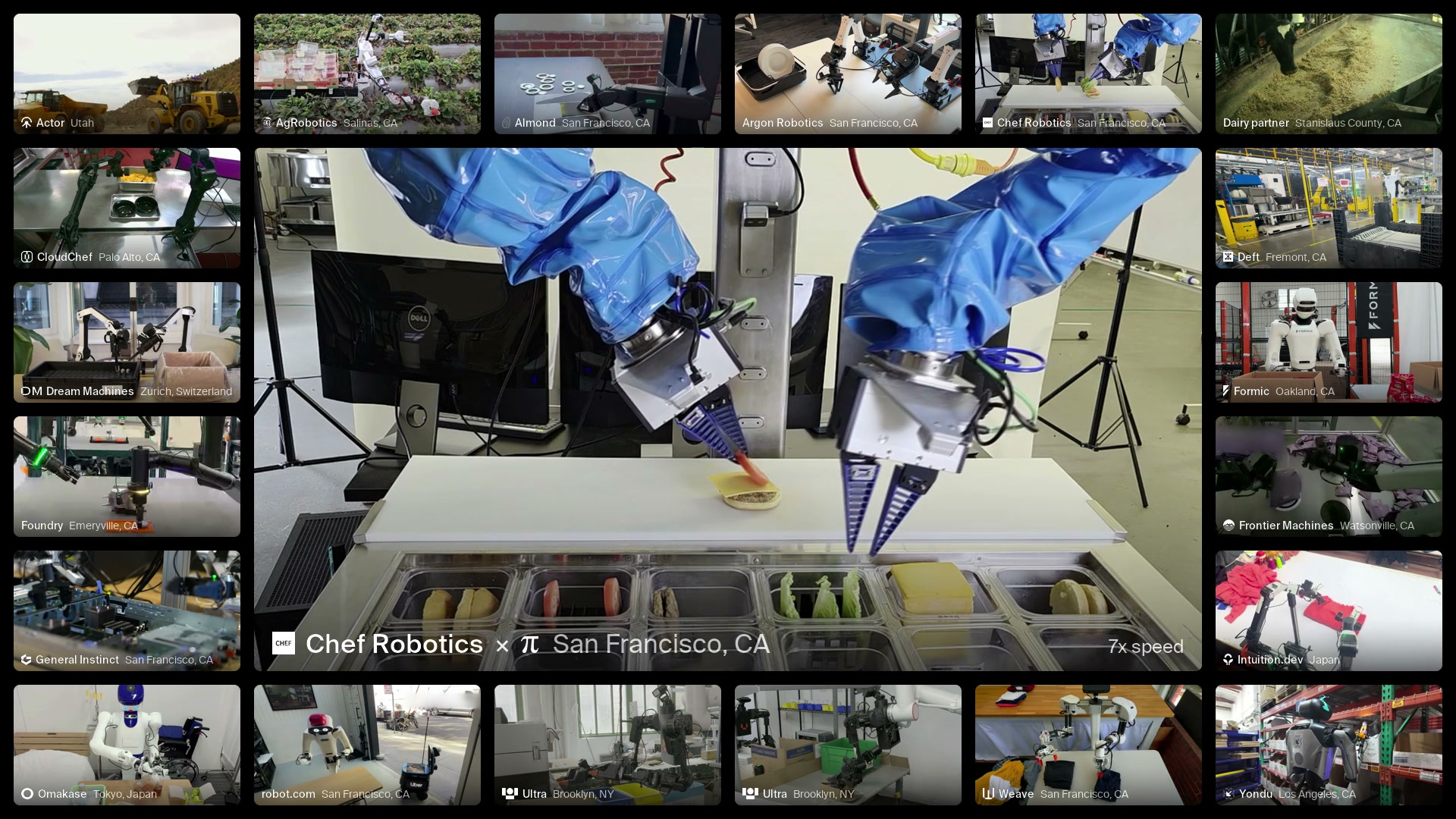
Teams can upload their robot data, launch fine-tuning on PI-managed compute and infrastructure, and run the resulting models through hosted inference. Early users include Argon Robotics, which trained a dish-racking policy within 35 hours, and General Instinct, which trained a server-assembly policy within three days. Beta participation is by application; most showcased applications use cloud-hosted inference, with network connectivity identified as an area for improvement.
Source - 2026-06-22 - Product Launch - Robot.com launches R-noid humanoid service platform
Restaurant Assistant, Packer, Picker, Folder and Host were the initial categories, spanning industrial, logistics, healthcare, food-service, lodging and experience settings. Dual seven-joint arms, an articulated torso and a holonomic base provide up to 1.9 meters of vertical reach; the company advertised an eight-to-twelve-week path from site visit to operation.
Source - 2026-05-21 - Funding - Physical Intelligence records USD 1.05B Series C at USD 11.19B post-money valuation
Forge certificate data reports a USD 502.90 price per share and USD 11.19 billion post-money valuation. Founders Fund, Lightspeed Venture Partners, Lux Capital and Thrive Capital are identified as key investors in the financing. The completed round follows the company's USD 600 million Series B at a USD 5.6 billion post-money valuation in November 2025.
Source - 2026-04-16 - Research Publication - Physical Intelligence publishes pi0.7 steerable robotic foundation model
Physical Intelligence published pi0.7 as a steerable robotic foundation model with stronger generalization and task recombination abilities. The official release compares pi0.7 against specialist policies on laundry folding, espresso making, and box folding while highlighting cross-platform generalization. The release is PI's most recent first-party generalist model release and belongs in the company research tab rather than only the generic timeline.
Source - 2026-03-19 - Research Publication - Physical Intelligence publishes RLT research on efficient online RL for precise robot manipulation
Physical Intelligence published RLT, an online reinforcement-learning method for precise robot manipulation. The work focuses on improving task performance efficiently through real-world policy updates.
Source - 2026-03-03 - Research Publication - Physical Intelligence publishes Multi-Scale Embodied Memory for long-horizon VLA tasks
Physical Intelligence published Multi-Scale Embodied Memory as a way to give VLA policies both short-term and long-term task memory. The official page frames MEM as enabling complex tasks lasting more than ten minutes, with high-level subtasks selected at lower frequency and actions selected at high frequency. Memory is a core missing capability for robots expected to complete long household and workplace workflows.
Source - 2025-12-16 - Research Publication - Physical Intelligence studies emergence of human-to-robot transfer in VLA models
Physical Intelligence published research on how transfer from human videos to robotic tasks emerges as VLA models scale. The official page studies when human-video pretraining begins to help robotic task performance rather than staying disconnected from robot action data. Human-to-robot transfer is central to scaling robot datasets beyond expensive teleoperation alone.
Source - 2025-11-20 - Funding - Physical Intelligence raises $600M round led by CapitalG at $5.6B valuation
Physical Intelligence raised $600 million in a new funding round valuing the company at $5.6 billion. Bloomberg reported CapitalG led the round, with participation from existing investors including Lux Capital, Thrive Capital, and Jeff Bezos, plus new investors including Index Ventures and T. Rowe Price. The financing marked a major follow-on raise for Physical Intelligence as investors accelerated bets on robot foundation models.
Source - 2025-11-17 - Research Publication - Physical Intelligence publishes pi-star-0.6 VLA that learns from experience
Physical Intelligence published pi-star-0.6 as a VLA trained with Recap-style reinforcement learning from autonomous robot experience. The release reports improvements on real-world application tasks such as box building, kitchen cleaning, and making coffee. The release moves the PI research timeline from imitation-style policy learning toward policies that improve through deployed experience.
Source - 2025-06-09 - Research Publication - Physical Intelligence publishes real-time action chunking for high-latency VLA control
Physical Intelligence published Real-Time Action Chunking as a method for keeping VLA-controlled robots precise while large models think over future action chunks. The official page frames the approach as an inpainting problem that keeps new action chunks consistent with actions already being executed. Inference latency is a practical blocker for deploying large robot foundation models on physical robots.
Source - 2025-05-28 - Research Publication - Physical Intelligence publishes VLA training method for faster training and stronger generalization
Physical Intelligence published a VLA training method focused on faster training, fast inference, and improved semantic generalization. The official page describes training with pi0-FAST action tokens, general web-data representation learning, and continuous actions through the action expert. The release fills an important research step between pi0.5 and later PI model releases.
Source - 2025-04-22 - Research Publication - Physical Intelligence publishes pi0.5 VLA for open-world generalization
Physical Intelligence published pi0.5 as a VLA model focused on open-world generalization across messy homes and unstructured tasks. The official writeup emphasizes co-training on heterogeneous data so the model can transfer knowledge across robots, instructions, and semantic task contexts. The release marks a clear step from lab dexterity toward general-purpose household and workplace robot behavior.
Source - 2025-02-04 - Research Publication - Physical Intelligence open-sources pi0 weights and openpi repository
Physical Intelligence released code and model weights for pi0 through its experimental openpi repository. The release includes base pretrained checkpoints, fine-tuned checkpoints for platforms such as ALOHA and DROID, and example code for real and simulated robots. The release made a general-purpose robot foundation model available for researchers and developers to adapt to their own platforms.
Source - 2025-01-16 - Research Publication - Physical Intelligence releases FAST robot action tokenizer for efficient VLA training
Physical Intelligence published FAST, an efficient robot action tokenizer designed to connect high-frequency robot action chunks to autoregressive transformer training. FAST was trained on one million real robot action sequences and supports faster pi0-FAST policy training while retaining dexterous-control capability. Tokenizer and dataset infrastructure are part of the research substrate behind scalable robotic foundation models.
Source - 2024-11-04 - Funding - Physical Intelligence raises $400 million for general-purpose robot foundation models
Physical Intelligence raised $400 million to develop general-purpose AI models and algorithms for real-world robots. The company is building foundation models for physical intelligence, with the goal of creating a generalist robot brain that can control many robot embodiments. The financing followed a $70 million seed round earlier in 2024 and reportedly valued the company at roughly $2 billion to $2.4 billion before or after the new investment, depending on source framing.
Source - 2024-11-04 - Funding - Physical Intelligence raises $400M from Bezos, OpenAI, Thrive, and Lux
Physical Intelligence raised $400 million in early-stage funding for foundational software for robots. Reported participants included Jeff Bezos, OpenAI, Thrive Capital, Lux Capital, and other venture backers. The round made Physical Intelligence one of the best-funded early robotics foundation-model companies shortly after its launch.
Source - 2024-10-31 - Research Publication - Physical Intelligence introduces pi0 general-purpose robot foundation model
Physical Intelligence introduced pi0 as its first generalist robot policy, combining a vision-language model backbone with action generation for dexterous robot control. The official release describes training across multiple robot forms and tasks including laundry folding, table cleaning, grocery bagging, and box assembly. Pi0 is one of the core first-party foundation-model releases in the modern robotics stack.
Source
Relations
Relationships
- Robot.com
R Noid Manipulation Model Partner - Physical Intelligence's π0.7 vision-language-action model supports R-Noid generalist manipulation.
- Ultra
Partner - Ultra used Physical Intelligence's pi 0.6 model in live customer deployments packaging real orders, including a full-shift 96.4% autonomy result.
- Intuition.dev
Pi API Collaboration - Intuition.dev uses the Pi API to train and deploy clothing-handling policies at Sandro.
- Dream Machines
Robot Model Collaboration / Pi API Partner - Dream Machines uses the Pi API for manufacturing automation. Its three-person team produced a fine-tuned actuator-unboxing model in about 18 hours.
Context
Comparable profiles
- X Square Robot
comparable profile - Vla Robot Policy Developer
- MiraiBit
comparable profile - Vla Robot Policy Developer
- Dream Labs
comparable profile - Robot Foundation Model Developer
- PHYMI
comparable profile - Vla Robot Policy Developer
- XIRRA
comparable profile - Robot Foundation Model Developer
- ACE Robotics (大晓机器人)
comparable profile - Robot Foundation Model Developer
- RLWRLD
comparable profile - Robot Foundation Model Developer
- Saturn Dynamics
comparable profile - Robot Foundation Model Developer
Shared workflows
- Intelligence Factory
workflow adjacency - Cross Embodiment Robot Learning
- RoboScience / 机器科学
workflow adjacency - Cross Embodiment Robot Learning
- Reward AI
workflow adjacency - Cross Embodiment Robot Learning
- DexForce
workflow adjacency - Embodied World Model Training
- Ropedia
workflow adjacency - Embodied World Model Training
- Aether AI
workflow adjacency - Embodied World Model Training
- Worldmodeldata
workflow adjacency - Embodied World Model Training
- MAUM.AI
workflow adjacency - Embodied World Model Training
- Noetive
workflow adjacency - Embodied World Model Training
Context tags
- Robot-learning infrastructure stack - Stack Layer - Physical Intelligence provides robot learning infrastructure for policy training.
- Cross-embodiment robot learning - Workflow - Physical Intelligence trains cross-embodiment robot policies.
- Generalist robot policy - Capability - Physical Intelligence develops generalist robot control policies.
- Robot foundation model platform - Stack Layer - Physical Intelligence provides robot foundation model infrastructure.
- Robot foundation model developer - Peer Group - Physical Intelligence develops robot foundation models including pi0 and VLA generalist policies.
- VLA robot policy developer - Peer Group - Physical Intelligence publishes the pi family of general robot vision-language-action policies: https://www.physicalintelligence.company/download/pi0.pdf
- Robot policy learning - Workflow - Physical Intelligence trains robot policies across embodiments and tasks.
- Embodied world model training - Workflow - Physical Intelligence develops world model training for embodied AI.
- Robot world model platform - Stack Layer - Physical Intelligence provides robot world model platforms.
- Robot model supply chain - Customer Environment - Physical Intelligence serves the robot model and embodied AI supply chain.