
Isaac Lab
About
About Isaac Lab
Isaac Lab provides modular robot assets, sensors, environments and task definitions for training control policies in GPU-accelerated simulation. Researchers can run many parallel environments for reinforcement learning, imitation learning, motion planning and domain-randomisation across manipulators, humanoids and mobile robots.
The framework is built on NVIDIA Isaac Sim and connects with major learning libraries and robotics-development tools. Policies can be evaluated across varied materials, lighting, sensor noise and dynamics before deployment on physical machines. Isaac Lab also provides simulation infrastructure for NVIDIA GR00T workflows.

Capabilities
Source-backed capabilities
- Workflows: Simulation and Validation
- Operating environments: Research labs, robot developers, simulation teams and AI training environments.
- Target markets: Robotics labs, AI developers and companies training policies before physical deployment.
- Deployment model: Open framework and NVIDIA developer ecosystem model.
- Navigation and obstacle avoidance
Research demonstration - 2026-04-26 - The study proposes AWARE, Adaptive Wheeled-Legged Avoidance and Reflexive Evasion, a hierarchical reinforcement learning framework for high-dynamic obstacle avoidance in wheeled-legged robots.
Source - Multi-terrain locomotion
Research demonstration - 2026-03-28 - Across more than 70 experiments organized into fourteen waves on a DHAV1 12-DoF quadruped in Isaac Lab, the agent progressed from early rough-terrain runs with mean reward around 7 to a best logged Wave 12 run, exp063, with velocity error 0.263 and 97\% timeout over 2000 iterations, independently reproduced five times…
Source - Bipedal walking
Research demonstration - 2026-03-22 - Evaluating Factor-Wise Auxiliary Dynamics Supervision for Latent Structure and Robustness in Simulated Humanoid Locomotion
Source - Stair climbing
Research demonstration - 2026-02-03 - Training and Simulation of Quadrupedal Robot in Adaptive Stair Climbing for Indoor Firefighting: An End-to-End Reinforcement Learning Approach
Source - Object manipulation
Research demonstration - 2026-06-17 - Tactile sensing provides direct measurements of contact interactions that are essential for robotic manipulation.
Source - Whole-body loco-manipulation
Research demonstration - 2026-06-10 - The paper compares unified and dual critic architectures for humanoid loco-manipulation reinforcement learning.
Source - Dexterous manipulation
Research demonstration - 2025-05-24 - The method is tested on eight Isaac Lab benchmarks spanning locomotion, dexterous manipulation, aerial control and robot arms.
Source - Pick and place
Claimed - 2025-01-06 - The release also adds reference workflows for pick-and-place and object-following plus visual-SLAM and multi-camera 3D reconstruction, giving developers a path from simulation and synthetic data toward physical robot deployment.
Source - Remote and shared control
Research demonstration - 2026-05-26 - The authors present VR-DAgger, a human-in-the-loop framework centered on an immersive VR application for dexterous teleoperation, demonstration collection, and selective policy correction.
Source - Crop and field operations
Research demonstration - 2026-05-22 - These results illustrate that task-specific perception combined with simulation-trained PPO can serve as a practical and resource-efficient alternative to conventional planner-dependent reaching in manipulation, enabling reliable closed-loop robotic harvesting in complex agricultural environments.
Source - Crop harvesting
Research demonstration - 2026-05-22 - These results illustrate that task-specific perception combined with simulation-trained PPO can serve as a practical and resource-efficient alternative to conventional planner-dependent reaching in manipulation, enabling reliable closed-loop robotic harvesting in complex agricultural environments.
Source
Observed use
Exact-product configurations are shown without inferring supply, purchase, customer status, standard fit, deployment or partnership.
- Sharpa Wave
2026-03-09 - Digital Simulation - Connected - Simulated - A MANUS demonstration teleoperated a simulated 22-DoF Sharpa Wave inside NVIDIA Isaac Lab 2.3 and fed demonstrations into Isaac Lab Mimic.
Source
Research
- Isaac Sim-to-Real: Reinforcement Learning based Locomotion for Quadrupeds
2026-07-20 - Research Publication - Reinforcement learning (RL), the primary learning-based approach for locomotion, often utilizes a high-performance simulation tool, providing a controlled and efficient training and development environment. The proposed RL framework utilizes Nvidia's new set of simulation tools, Isaac Sim, and its companion RL framework, Isaac Lab, for training, achieving a zero-shot sim-to-real policy. The performance of their policy is validated on physical hardware using the Unitree Go1, with experimental results showing similar velocity tracking performance to the quadruped's integrated controller, with a greater ability to recover from large disturbances, and achieve linear velocities of 2.0 m/s and angular velocities of 1.8 rad/s.
Source - AeroAct: Action-Centered World-Action Models for Language-Conditioned Quadrotor Flight
2026-07-16 - Research Publication - The authors present AeroAct, an action-centered world-action model (WAM) for quadrotor navigation. To obtain aligned visual, state, language, and dynamically feasible action data, the authors build a DiffAero-based pipeline with complementary Isaac Lab and 3D Gaussian splatting renderers. Closed-loop simulation and real-world experiments show that temporal visual context improves target tracking and object-search performance, and that WAM-based policies can be executed on a physical quadrotor.
Source - EVIS: A Physics-Grounded Event Camera Plugin for NVIDIA Isaac Sim
2026-07-09 - Research Publication - However, labeled event-camera data for a specific robot and scene is scarce and expensive to collect, which slows the development of event-based perception and control. The plugin implements a faithful log-intensity contrast event model with per-pixel asynchronous reference updates; it migrates from a normal RGB camera with few changes and integrates into any Isaac Sim / Isaac Lab scene, inheriting the simulator's physics and frame-perfect ground truth.
Source - GPUSimBench: Towards Scalable and Reliable GPU-Accelerated Simulators in Embodied AI
2026-07-06 - Research Publication - However, as computational throughput scales, the underlying trade-offs between parallel efficiency, physical fidelity, and execution determinism remain largely unexamined, hindering the development of reliable robot learning. The study exposes the hidden limits of mainstream GPU-based robotic simulators (e.g., Isaac Lab, Genesis) by introducing GPUSimBench, which focuses on scalability, physical consistency, and computational determinism. First, GPUSimBench establishes a physical grounding evaluation with a controlled inclined-plane task, quantifying the distributional alignment between simulated dynamics and their real-world counterparts.
Source - NavIsaacLab: Generating Realistic Crowd via Parallel Robot Learning for Benchmarking Human-aware Navigation
2026-06-24 - Research Publication - Existing simulation platforms often rely on handcrafted rules to approximate pedestrian behavior and lack the capability to provide extensive sensor signals, typically assuming perfect observations. Based on Isaac Lab, the proposed framework employs photo-realistic scene rendering capabilities and supports parallel simulation on GPU, delivering real-time and accurate 3D visual feedback to robots.
Source - TactSpace: Learning a Physics-enriched Shared Latent Space for Tactile Sim-to-Real Transfer
2026-06-17 - Research Publication - Tactile sensing provides direct measurements of contact interactions that are essential for robotic manipulation. Finally, the authors release an efficient Warp-based implementation of a penalty-based tactile simulation model for Isaac Lab, enabling scalable tactile data generation.
Source - Steering Generative Reinforcement Learning into Stable Robotic Controller
2026-06-15 - Research Publication - SteerGenPO replaces stochastic diffusion-policy sampling with a learned state-conditioned latent actor for stable deterministic control at deployment. The method is evaluated on six Isaac Lab benchmarks and a Unitree G1 locomotion task. The authors report gains over classical and generative reinforcement-learning baselines with more stable behavior and command response.
Source - Dual-critic humanoid loco-manipulation paper trains Unitree G1 policies in NVIDIA Isaac Lab
2026-06-10 - Research Publication - The paper compares unified and dual critic architectures for humanoid loco-manipulation reinforcement learning. Experiments train Unitree G1 policies through a 13-level curriculum in NVIDIA Isaac Lab.
Source - GPU-Parallel Multi-Task Reinforcement Learning with Demonstration Guided Policy Optimization
2026-06-02 - Research Publication - The authors propose a construction methodology for turning structured manipulation task families into GPU-parallel multi-task RL benchmarks, and instantiate it as MT-Libero using LIBERO assets and task predicates in Isaac Lab. The resulting benchmark supports simultaneous reinforcement learning over heterogeneous task suites with parallel rendering, physics randomization, and state-input or visual-input policies.
Source - Batched Differentiable Rigid Body Dynamics in PyTorch for GPU-Accelerated Robot Learning
2026-05-29 - Research Publication - The authors present BARD (Batched Articulated Rigid-body Dynamics), a self-contained PyTorch implementation of Featherstone's rigid-body dynamics algorithms, optimized for batched GPU evaluation and automatic differentiation. The authors validate differentiability through gradient-based system identification on a 7-DOF manipulator, recovering link masses to 1.24% mean error under 5% torque noise, and integrate BARD into an Isaac Lab AMP training pipeline for an 11-DOF spined quadruped with 4096 parallel environments, where it is 8.5x faster than Pinocchio and 2.0x faster than ADAM for in-loop dynamics.
Source - VR-DAgger: Immersive VR for Dexterous Data Collection and Uncertainty-Guided On-Policy Correction
2026-05-26 - Research Publication - The authors present VR-DAgger, a human-in-the-loop framework centered on an immersive VR application for dexterous teleoperation, demonstration collection, and selective policy correction. The authors use Monte Carlo (MC) dropout to score uncertainty during Isaac Lab rollouts of a diffusion policy and select informative failure segments for correction. Active labeling consistently improves over behavioral cloning across all tasks, with gains of up to 23 percentage points.
Source - TienKung-Lab: Direct IsaacLab Workflow for TienKung
2026-05-23 - Research Publication - The codebase is built on IsaacLab, supports Sim2Sim transfer to MuJoCo, and features a modular architecture for seamless customization and extension. Warp: a Python framework for writing high-performance simulation and graphics code.
Source - Robotic Strawberry Harvesting with Robust Vision and Deep Reinforcement Learning based Sim-to-Real Control
2026-05-22 - Research Publication - This study presents a closed-loop robotic strawberry harvesting system that combines a robust vision module, simulation-trained deep reinforcement learning (DRL) control, and ROS-based realrobot execution. For control, the authors train a target-conditioned Proximal Policy Optimization (PPO) policy in Isaac Lab to produce smooth joint-position commands for a UR10e manipulator and deploy it on a UR10e robot for targetfruit reaching and harvesting. These results illustrate that task-specific perception combined with simulation-trained PPO can serve as a practical and resource-efficient alternative to conventional planner-dependent reaching in manipulation, enabling reliable closed-loop robotic harvesting in complex agricultural environments.
Source - CoRMA: Contrastive RMA for Contact-Rich Meta-Adaptation
2026-05-21 - Research Publication - The authors present CoRMA(Contrastive Robotic Motor Adaptation), a context-based meta-adaptation framework that modifies RMA for force-dominant assembly. The authors evaluate CoRMA on PegInsert, GearMesh, and NutThread in Isaac Lab / Isaac Sim 5.0 and on a real Marvin arm. These results support semantic contact inference as a reusable adaptation interface within a related assembly task family, while broader unseen-task generalization and Real2Sim calibration remain future work.
Source - parallelcbf: A composable safety-filter and auditability framework for tensor-parallel reinforcement learning
2026-05-15 - Research Publication - ParallelCBF unifies tensor-parallel UAV environments, control-barrier-function safety filters, behavior-cloning-to-RL pipelines, and operational auditability. The release includes a CPU PyTorch reference implementation, vectorized safety-invariance tests, and an auditable behavior-cloning collection campaign covering 31,415 episodes. In a reported end-to-end run, the auditability layer stopped a downstream training stage that failed its pre-registered convergence criteria.
Source - SceneFactory: GPU-Accelerated Multi-Agent Driving Simulation with Physics-Based Vehicle Dynamics
2026-05-08 - Research Publication - The authors introduce SceneFactory, a GPU-vectorized platform for procedural scene construction, physics-based multi-agent simulation, and RL in autonomous-driving environments. Built on NVIDIA Isaac Sim + Isaac Lab, SceneFactory represents worlds and agents as batched tensors: control, observations, rewards, resets, and policy inference run as GPU tensor operations over the Isaac Lab tensor API. Cross-simulator transfer reveals an asymmetric dynamics gap: physics-grounded RL policies transfer to a simplified kinematic bicycle model with 99.5% success, whereas reverse transfer drops to 47.3%.
Source - GR00T-VisualSim2Real: Visual Sim-to-Real at Scale for Humanoid Loco-Manipulation
2026-04-30 - Research Publication - Open-source pipeline for visual sim-to-real transfer of humanoid locomotion and manipulation skills. Includes training code, simulation assets, and workflows for learning behaviors such as walking and object interaction. Targets scalable deployment of humanoid policies without reliance on real-world teleoperation data.
Source - Unleashing the Agility of Wheeled-Legged Robots for High-Dynamic Reflexive Obstacle Evasion
2026-04-26 - Research Publication - The study proposes AWARE, Adaptive Wheeled-Legged Avoidance and Reflexive Evasion, a hierarchical reinforcement learning framework for high-dynamic obstacle avoidance in wheeled-legged robots. Extensive experiments in Isaac Lab simulation and real-world deployment on the M20 platform across diverse dynamic scenarios demonstrate that AWARE achieves robust and agile obstacle avoidance while revealing behaviorally distinct evasive strategies. These results highlight both the practical effectiveness of AWARE and the intrinsic reflexive agility of wheeled-legged robots.
Source - PriPG-RL paper validates planner-guided reinforcement learning with NVIDIA Isaac Lab
2026-04-09 - Research Publication - PriPG-RL combines privileged planner guidance with reinforcement learning for partially observable systems with anytime-feasible MPC. The authors validate the method in NVIDIA Isaac Lab and deploy it on a real Unitree Go2 quadruped in obstacle-rich environments.
Source - Agent-Driven Autonomous Reinforcement Learning Research: Iterative Policy Improvement for Quadruped Locomotion
2026-03-28 - Research Publication - A human provided high-level directives through an agentic coding environment, while an agent carried out most of the execution loop: reading code, diagnosing failures, editing reward and terrain configurations, launching and monitoring jobs, analyzing intermediate metrics, and proposing the next wave of experiments. Across more than 70 experiments organized into fourteen waves on a DHAV1 12-DoF quadruped in Isaac Lab, the agent progressed from early rough-terrain runs with mean reward around 7 to a best logged Wave 12 run, exp063, with velocity error 0.263 and 97\% timeout over 2000 iterations, independently reproduced five times across different GPUs. Relative to the AutoResearch paradigm \cite{autoresearch}, this case study operates in a more failure-prone robotics RL setting with multi-GPU experiment management and simulator-specific engineering constraints.
Source - Evaluating Factor-Wise Auxiliary Dynamics Supervision for Latent Structure and Robustness in Simulated Humanoid Locomotion
2026-03-22 - Research Publication - A 2x2 factorial ablation (n = 10 seeds) isolates the contributions of the tanh bottleneck and auxiliary losses: the auxiliary losses show no measurable effect on either in-distribution (ID) reward (+0.03, p = 0.732) or severe out-of-distribution (OOD) reward (+0.03, p = 0.669), while the bottleneck shows a small, consistent advantage in both regimes (ID: +0.16, p = 0.207; OOD: +0.10, p = 0.208). DynaMITE -- a transformer encoder with a factored 24-d latent trained by per-factor auxiliary losses during proximal policy optimization (PPO) -- is compared against Long Short-Term Memory (LSTM), plain Transformer, and Multilayer Perceptron (MLP) baselines on a Unitree G1 humanoid across four Isaac Lab tasks. For locomotion practitioners: auxiliary dynamics supervision does not produce an interpretable estimator and does not measurably improve reward or robustness beyond what the bottleneck alone provides; recurrent baselines remain the stronger choice for nominal performance.
Source - PRIOR: Perceptive Learning for Humanoid Locomotion with Reference Gait Priors
2026-03-19 - Research Publication - Comprehensive experiments across terrains of varying difficulty-including stairs, boxes, and gaps-demonstrate that each component yields complementary and essential performance gains, with the full framework achieving a 100% traversal success rate. The authors will open-source the complete PRIOR framework, including the training pipeline, parametric gait generator, and evaluation benchmarks, to serve as a reproducible foundation for humanoid locomotion research on Isaac Lab.
Source - Learning Energy-Efficient Air--Ground Actuation for Hybrid Robots on Stair-Like Terrain
2026-03-13 - Research Publication - The authors propose an energy-aware reinforcement learning framework that trains a single continuous policy to coordinate propellers, wheels, and tilt servos without predefined aerial and ground modes. The authors train policies from proprioception and a local height scan in Isaac Lab with parallel environments, using hardware-calibrated thrust/power models so the reward penalizes true electrical energy. These results show that efficient hybrid actuation can emerge from learning and deploy on hardware.
Source - Embedding Classical Balance Control Principles in Reinforcement Learning for Humanoid Recovery
2026-03-09 - Research Publication - The recovery policy embeds capture point, center-of-mass state and centroidal momentum into critic inputs and balance-shaped rewards. Training on Unitree H1-2 in Isaac Lab yields a reported 93.4 percent recovery rate across randomized poses and unscripted falls. The paper reports simulation transfer to MuJoCo and preliminary hardware experiments, but no exact H1-2 product row is currently tracked.
Source - Vision-based omnidirectional-navigation paper trains teacher policy in NVIDIA Isaac Lab
2026-03-02 - Research Publication - The paper presents a teacher-student approach for vision-based mobile robot navigation using monocular depth estimation. A teacher policy is trained with PPO in NVIDIA Isaac Lab using privileged 2D LiDAR observations before distillation to a monocular-depth student policy.
Source - UEREBot: Learning Safe Quadrupedal Locomotion under Unstructured Environments and High-Speed Dynamic Obstacles
2026-02-07 - Research Publication - UEREBot separates long-horizon spatial-temporal planning from fast reflexive evasion and adds a control-barrier safety shield. The framework is evaluated in Isaac Lab and deployed on a Unitree Go2 with onboard perception. Across static structure and high-speed dynamic obstacles, the authors report better avoidance and stability while maintaining goal progress.
Source - Residual Reinforcement Learning for Waste-Container Lifting Using Large-Scale Cranes with Underactuated Tools
2026-02-05 - Research Publication - This paper studies the container lifting phase of a waste-container recycling task in urban environments, performed by a hydraulic loader crane equipped with an underactuated discharge unit, and proposes a residual reinforcement learning (RRL) approach that combines a nominal Cartesian controller with a learned residual policy. A PPO-trained residual policy in Isaac Lab compensates for unmodeled dynamics and parameter variations, improving precision and robustness without requiring end-to-end learning from scratch. Simulation results demonstrate improved tracking accuracy, reduced oscillations, and higher lifting success rates compared to the nominal controller alone.
Source - Training and Simulation of Quadrupedal Robot in Adaptive Stair Climbing for Indoor Firefighting: An End-to-End Reinforcement Learning Approach
2026-02-03 - Research Publication - In this project, the authors designed a two-stage end-to-end deep reinforcement learning (RL) approach to optimize both navigation and locomotion. In the first stage, the quadrupeds, Unitree Go2, were trained to climb stairs in Isaac Lab's pyramid-stair terrain.
Source - mjlab: A Lightweight Framework for GPU-Accelerated Robot Learning
2026-01-29 - Research Publication - The authors present mjlab, a lightweight, open-source framework for robot learning that combines GPU-accelerated simulation with composable environments and minimal setup friction. mjlab adopts the manager-based API introduced by Isaac Lab, where users compose modular building blocks for observations, rewards, and events, and pairs it with MuJoCo Warp for GPU-accelerated physics. The result is a framework installable with a single command, requiring minimal dependencies, and providing direct access to native MuJoCo data structures. mjlab ships with reference implementations of velocity tracking, motion imitation, and manipulation tasks.
Source - Enhancing Control Policy Smoothness by Aligning Actions with Predictions from Preceding States
2026-01-26 - Research Publication - The study proposes a novel loss-based method by introducing a transition-induced similar state. Experiments in Gymnasium and Isaac-Lab environments demonstrate that ASAP yields smoother control and improved policy performance over existing methods.
Source - Online diffusion-policy RL review benchmarks algorithms on NVIDIA Isaac Lab tasks
2026-01-05 - Research Publication - The review organizes online diffusion policy reinforcement-learning algorithms by policy-improvement mechanism. The paper evaluates representative algorithms on a unified NVIDIA Isaac Lab benchmark covering 12 robotic tasks.
Source - Autonomous Reinforcement Learning Robot Control with Intel's Loihi 2 Neuromorphic Hardware
2025-12-03 - Research Publication - The authors present an end-to-end pipeline for deploying reinforcement learning (RL) trained Artificial Neural Networks (ANNs) on neuromorphic hardware by converting them into spiking Sigma-Delta Neural Networks (SDNNs). The policy, trained with Rectified Linear Units (ReLUs), is converted to an SDNN and deployed on Intel's Loihi 2, then evaluated in NVIDIA's Omniverse Isaac Lab simulation environment for closed-loop control of Astrobee's motion. The results highlight the feasibility of using neuromorphic platforms for robotic control and establish a pathway toward energy-efficient, real-time neuromorphic computation in future space and terrestrial robotics applications.
Source - APIARY Astrobee paper trains free-flyer control policy in NVIDIA Isaac Lab
2025-12-03 - Research Publication - The APIARY paper describes reinforcement-learning control for autonomous planning in-space assembly using the International Space Station Astrobee platform. A six-degree-of-freedom control policy is trained with PPO in NVIDIA Isaac Lab using randomized goal poses and mass distributions.
Source - Isaac Lab: A GPU-Accelerated Simulation Framework for Multi-Modal Robot Learning
2025-11-06 - Research Publication - Isaac Lab includes Digit among 11 simulated robot morphologies in its locomotion environment suite. The Digit rough-terrain benchmark uses a 1.6-by-1.2-metre RayCaster height scanner at 0.1-metre resolution and models closed-loop kinematic chains. The report benchmarks perceptive locomotion throughput across L40, RTX Pro 6000 and GeForce 5090 GPUs; the Digit results are simulation-only.
Source - GBC: Generalized Behavior-Cloning Framework for Whole-Body Humanoid Imitation
2025-08-13 - Research Publication - This paper introduces the Generalized Behavior Cloning (GBC) framework, a comprehensive and unified solution designed to solve this end-to-end challenge. To complete the ecosystem, the entire framework is delivered as an efficient, open-source platform based on Isaac Lab, empowering the community to deploy the full workflow via simple configuration scripts. The authors validate the power and generality of GBC by training policies on multiple heterogeneous humanoids, demonstrating excellent performance and transfer to novel motions.
Source - HybridRobotics/whole_body_tracking
2025-08-11 - Research Publication - BeyondMimic Motion Tracking Code [[Website]]( [[Arxiv]]( [[Video]]( Overview BeyondMimic is a versatile humanoid control framework that provides highly dynamic motion tracking with the state-of-the-art motion quality on real-world deployment and steerable test-time control with guided diffusion-based controllers. Alternative Implementations - There is an alternative reproduction of BeyondMimic in mjlab, a new Isaac Lab-style manager API powered by MuJoCo-Warp for RL and robotics research. Code Structure Below is an overview of the code structure for this repository: - source/whole body tracking/whole body tracking/tasks/tracking/mdp This directory contains the atomic functions to define the MDP for BeyondMimic.
Source - GenPO: Generative Diffusion Models Meet On-Policy Reinforcement Learning
2025-05-24 - Research Publication - GenPO makes diffusion policies compatible with on-policy reinforcement learning through exact diffusion inversion and an invertible doubled-action mechanism. The method is tested on eight Isaac Lab benchmarks spanning locomotion, dexterous manipulation, aerial control and robot arms. Tracked exact benchmark platforms include Unitree H1 and Go2; the generic ANYmal link was removed because the source specifies ANYmal-D.
Source - RoboRAN: A Unified Robotics Framework for Reinforcement Learning-Based Autonomous Navigation
2025-05-20 - Research Publication - The study presents a multi-domain framework for training, evaluating and deploying RL-based navigation policies across diverse robotic platforms and operational environments. To support the community, the authors release RoboRAN as open-source.
Source - Wheeled Lab: Modern Sim2Real for Low-cost, Open-source Wheeled Robotics
2025-02-11 - Research Publication - As a result, broader communities are disconnecting from the state-of-the-art; education curricula are poorly equipped to teach indispensable modern robotics skills involving hardware, deployment, and iterative development. To address this gap between the broader and scientific communities, the authors contribute Wheeled Lab, an ecosystem which integrates accessible, open-source wheeled robots with Isaac Lab, an open-source robot learning and simulation framework, that is widely adopted in the state-of-the-art. To kickstart research and education, this work demonstrates three state-of-the-art zero-shot policies for small-scale RC cars developed through Wheeled Lab: controlled drifting, elevation traversal, and visual navigation.
Source - TacEx: GelSight Tactile Simulation in Isaac Sim -- Combining Soft-Body and Visuotactile Simulators
2024-11-07 - Research Publication - To close this gap, the authors develop TacEx -- a modular tactile simulation framework. The authors implement several Isaac Lab environments for Reinforcement Learning (RL) leveraging their TacEx simulation, including object pushing, lifting, and pole balancing. The code, videos, and additional results will be released online https://sites.google.com/view/tacex.
Source - fan-ziqi/robot_lab
2024-07-06 - Research Publication - robot_lab is an Apache-2.0 reinforcement-learning extension built on NVIDIA Isaac Lab. Its README registers exact model-specific simulation environments across quadruped, wheeled-quadruped and humanoid platforms, including the tracked products routed here. The repository provides runnable training and playback commands; it directs Gazebo and real-robot execution to the separate rl_sar project.
Source - isaac-sim/IsaacLab
2022-11-16 - Research Publication - Isaac Lab provides developers with a range of essential features for accurate sensor simulation, such as RTX-based cameras, LIDAR, or contact sensors. Support Please use GitHub Discussions for discussing ideas, asking questions, and requests for new features.
Source - pytorch/rl
2022-02-01 - Research Publication - That common data model is TensorDict, a dictionary-like tensor container with PyTorch operations, device transfers, shared-memory support, memmaps, lazy views, and nn.Module wrappers. Breaking changes can happen, but TorchRL aims to introduce them with deprecation warnings over multiple release cycles.
Source - leggedrobotics/rsl_rl
2021-10-18 - Research Publication - RSL-RL can also be used out-of-the-box by installing it via PyPI, supports multi-GPU training, and features common algorithms for robot learning. Key Features - Minimal, readable codebase with clear extension points for rapid prototyping. - Robotics-first methods including PPO and Student-Teacher Distillation. - High-throughput training with native Multi-GPU support. - Proven performance in numerous research publications.
Source
Resources
Official documentation and source references for NVIDIA Isaac Lab. Research papers and routine release announcements are excluded.
- Isaac Lab documentation
WEB · Framework · NVIDIA Isaac Lab
Source - Isaac Lab quickstart guide
WEB · Getting started · NVIDIA Isaac Lab
Source - Isaac Lab source repository
WEB · Source code · NVIDIA Isaac Lab
Source
Timeline
- GR00T-VisualSim2Real: Visual Sim-to-Real at Scale for Humanoid Loco-Manipulation
2026-04-30 - Research Publication - Open-source pipeline for visual sim-to-real transfer of humanoid locomotion and manipulation skills. Includes training code, simulation assets, and workflows for learning behaviors such as walking and object interaction. Targets scalable deployment of humanoid policies without reliance on real-world teleoperation data.
Source - Humanoid Robot ‘Digit’ Powered by Whole-Body Control Foundation Model
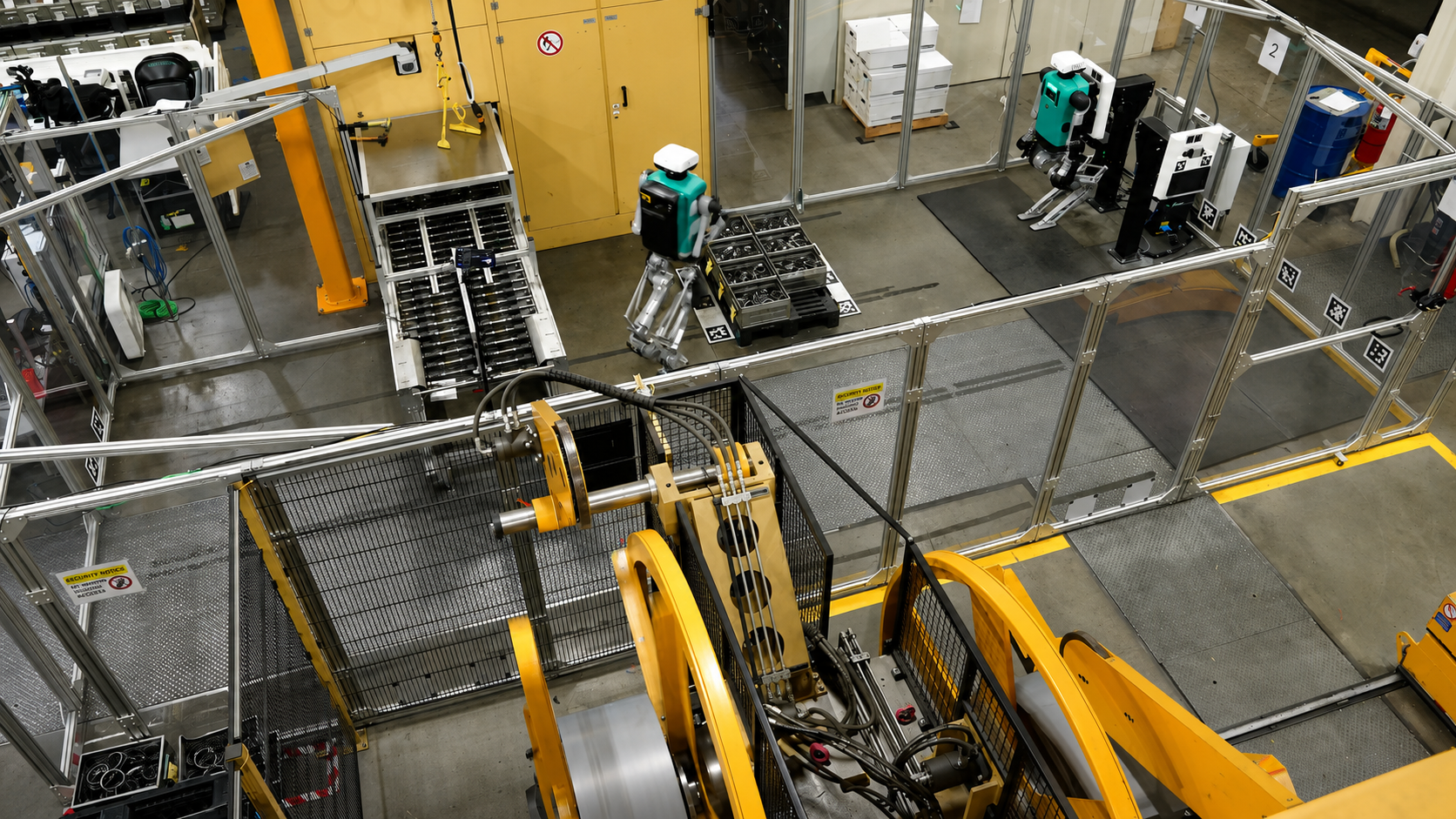
2025-08-25 - Partnership - These rollouts show that Digit’s OpenUSD-trained skills scale from logistics totes to metal stampings, giving Agility and NVIDIA a fast-growing partner ecosystem—and confirming that humanoid intelligence is ready for enterprise production. Caret right icon Click to expand Caret right icon Click to expand Caret right icon Click to expand menu.
Source - NVIDIA updates Isaac stack for robot learning, perception and manipulation
2025-01-06 - Product Launch - NVIDIA’s Isaac update spans Isaac Sim 4.5, Isaac Lab 2.0, Isaac Manipulator and Isaac Perceptor across simulation, learning, manipulation and AMR perception. Isaac Sim adds a customizable reference template, improved URDF setup and physics tooling, while Isaac Lab adds tiled rendering and simpler package and container installation. The release also adds reference workflows for pick-and-place and object-following plus visual-SLAM and multi-camera 3D reconstruction, giving developers a path from simulation and synthetic data toward physical robot deployment.
Source - NVIDIA releases Isaac Lab for robot learning and reinforcement learning workflows
2024-09-25 - Product Launch - NVIDIA launched Isaac Lab as an open-source framework for robot learning built on Omniverse Isaac Sim. The platform supports reinforcement learning, imitation learning, and large-scale simulation-based training for robotics. NVIDIA positioned Isaac Lab as a bridge between simulation and real-world deployment for robotics developers.
Source
Context
Market context
Isaac Lab is a robot training framework built on Isaac Sim, designed for reinforcement learning and policy training.
- Target environment: Research labs, robot developers, simulation teams and AI training environments.
- Workflow context: Policy training, reinforcement learning, sim-to-real experimentation and robot-learning benchmark workflows.
- Customer context: Robotics labs, AI developers and companies training policies before physical deployment.
- Deployment model: Open framework and NVIDIA developer ecosystem model.
- Commercial maturity: Active developer framework used by robotics researchers and simulation teams.
- Adoption constraints: Adoption depends on GPU access, simulator fidelity, workflow fit and the gap between simulated and physical robot behavior.
- Market position: Simulation and robot-learning infrastructure for embodied AI development.
- Adjacent products: LeRobot, MuJoCo, Lumo-1
Tags
- Workflow: Simulation and Validation
Related Systems
- Midcentury Matrix
Midcentury - Robotics Software
- Unity Simulation Pro
Unity - Robotics Software