
KaiBot
About
About KaiBot
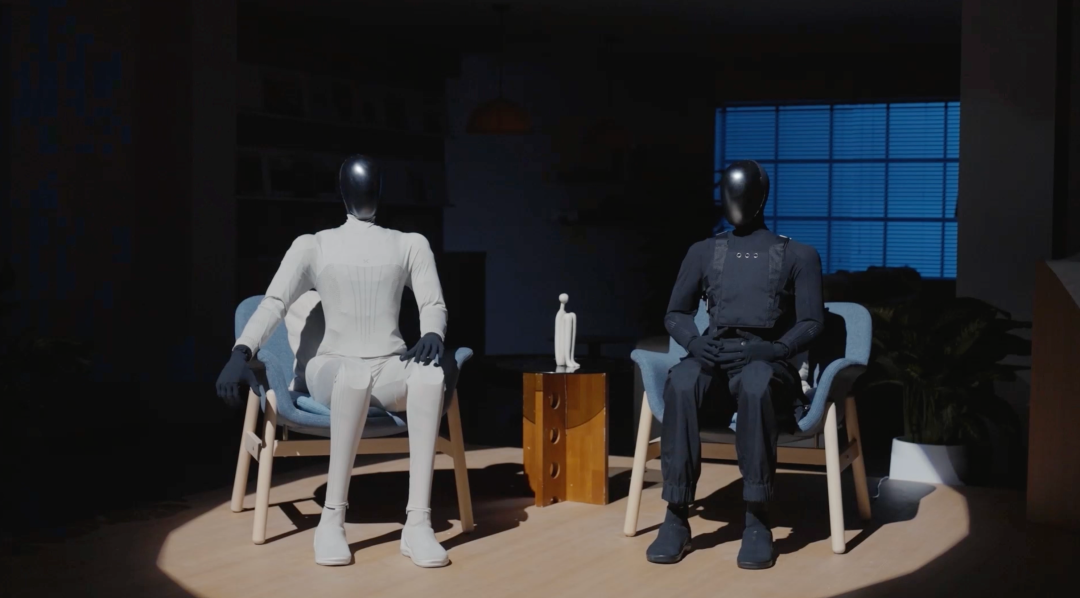
KaiBot is Kinetix AI's humanoid platform for developing whole-body movement, manipulation and interaction. The company develops the robot alongside its KAI Hand dexterous hand, combining hardware embodiment with learned control and a data pipeline for physical-world tasks. The platform is intended to connect perception and reasoning with coordinated actions through a humanlike body.
Kinetix AI's development system includes KAI Halo Lite data-collection equipment, the KAI EGO Dataset and infrastructure for training and evaluating robot intelligence. These tools support the collection of human experience and its transfer into robot behaviour. KaiBot has been presented in demonstrations involving handling, tools and service interactions, while the broader programme continues to develop the robot, its manipulation hardware and its learning software together.



Capabilities
Source-backed capabilities
- Operating environments: Intended factory work area
- Object sorting and classification
Claimed - Sort objects or components in factory workflows. - environment: Intended factory work area
Source - Material handling
Claimed - Transport materials within factory work areas. - environment: Intended factory work area
Source - Automated screwdriving
Claimed - Drive screws in configured factory assembly work. - environment: Intended factory work area
Source
Timeline
- Kinetix AI raises more than RMB500 million in Angel+ financing
2026-09-11 - Funding - Vertex Ventures, Fangguang Capital and Wanshi Capital were among the investors adding capital. The company plans to accelerate data infrastructure, embodied-model development and robot hardware iteration before commercialization. Kinetix had completed three earlier financings and employed nearly 200 people; its first full-size KaiBot was introduced in April 2026.
Source - Kinetix AI introduces KAI and its KaiBot humanoid hardware
2026-04-26 - Product Launch - KaiBot was specified at 173 centimetres and 70 kilograms, with 115 degrees of freedom; each 36-DOF hand included 22 actively controlled and 14 compliant degrees. A 1.7 kWh semi-solid battery was rated for about three hours of dual-arm operation, with a combined arm payload approaching 20 kilograms. The body’s approximately 18,000 tactile points were designed to detect contact above 0.1 newtons.
Source
Context
Market context
KAI is a Kinetix AI indoor service robot for commercial and public-facing environments, positioned around high-DOF humanoid interaction.
- Target environment: Home, factory and business service scenarios shown in Kinetix AI public material.
- Workflow context: Whole-body movement, human interaction, domestic assistance, light service tasks and embodied-AI research.
- Customer context: Robotics teams, research groups and future customers evaluating human-like humanoid platforms.
- Deployment model: Early company-controlled humanoid platform tied to Kinetix AI research and public demonstrations.
- Commercial maturity: Early public product page and launch coverage; broad customer deployment evidence is not yet disclosed.
- Adoption constraints: Adoption depends on product availability, reliability in everyday tasks, safety validation and service support.
- Market position: Human-like service humanoid lane, closer to household and public-interaction humanoids than industrial-only humanoid platforms.
- Adjacent products: Ai Qiu, Reachy Mini, home-service humanoids, humanoid robot platforms
Comparable Systems
- IRON
XPeng Inc. - humanoid robotics
- MagicBot Z1
MagicLab - Anthropomorphic Biped
- Figure 03
Figure AI - humanoid robotics
- LimX Oli
LimX Dynamics - Humanoid Platform
- Lumos LUS 2
Lumos Robotics - humanoid robotics
- 4NE1 Gen 4
Neura Robotics - humanoid robotics
Related Systems
- MenteeBot
Mentee Robotics - humanoid robotics
- Atlas
Boston Dynamics - humanoid robotics
- Walker C
UBTECH Robotics - Humanoid Platform
- Vanar Gen1
Vanar Robots - humanoid robotics
- NEO
1X Technologies - humanoid robotics
- AIDOL Walking Robot
AIDOL - humanoid robotics