
AI Sapiens K1
About
About AI Sapiens K1
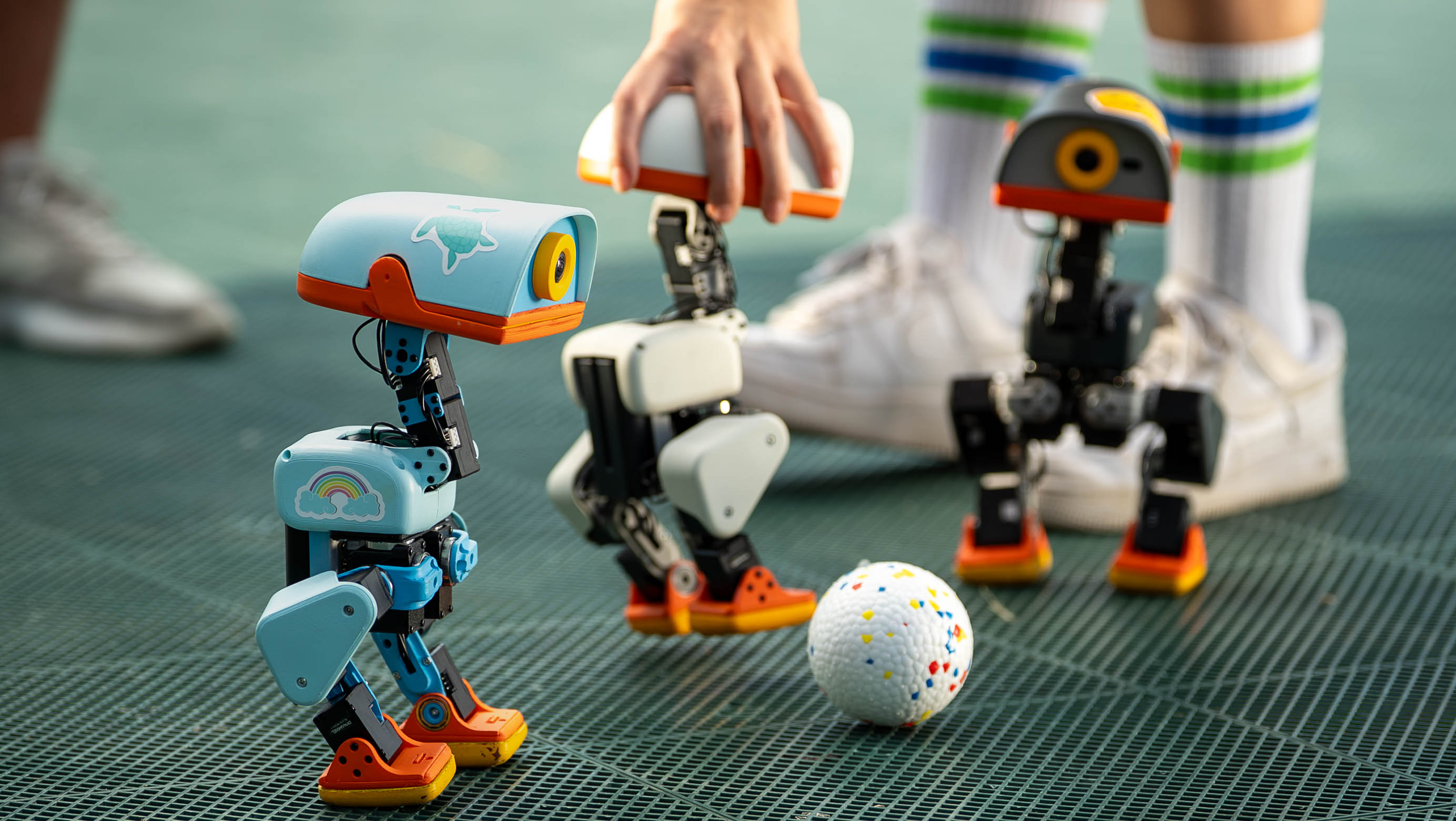
AI Sapiens K1 is ROBOTIS's bipedal humanoid platform for developing locomotion, upper-body motion and learned robot policies. It combines in-house DYNAMIXEL-Q actuators with onboard NVIDIA computing and a documented control stack, giving researchers a route from simulation and demonstrations to execution on physical hardware. Imitation-learning workflows use a leader-follower system to collect training examples, while reinforcement-learning tools support locomotion development.
K1 has 23 actuated joints across its arms, legs and waist. Its onboard software runs ROS2 Jazzy within a container on Cyclo OS, with impedance control connecting policy outputs to the actuator buses. ROBOTIS publishes software and development guides as part of an open-source programme. Mechanical bills of materials, STEP files and electrical design resources remain listed as forthcoming, so the public hardware documentation is still being expanded.



Capabilities
Source-backed capabilities
- Control modes: Teleoperation
- Bipedal walking
Claimed - Walk forwards, backwards and sideways and turn in response to controller gimbals.
Source
Supply
Supply / Components
- Built-in-house QDD actuator stack
ROBOTIS says K0 is powered by Dynamixel Q QDD actuators built in-house for efficiency, low backlash, and torque-level control.
Source
Research
- ROBOTIS AI Sapiens K1 ROS 2 packages
2026-07-21 - Research Publication - Official K1 humanoid development packages covering robot descriptions, bringup, controllers and simulation-to-real tools.
Source - ROBOTIS Cyclo Lab simulation environments
Research Publication - Cyclo Lab provides Isaac Lab environments, robot assets and reinforcement/imitation learning configurations for ROBOTIS robots. Exact configurations include FFW-SG2 pick-and-place and AI Sapiens K1 locomotion and motion imitation.
Source
Context
Comparable Systems
- Asimov 1
Menlo Research - Humanoid Robot
- Walker Tienkung
UBTECH Robotics - humanoid robotics
- KUAVO 4Pro
Leju Robotics - humanoid robotics
- Domo
Rotaku - humanoid robotics
- H2 Plus
Unitree - humanoid robotics
- ALICE 5
AeiROBOT - humanoid robotics